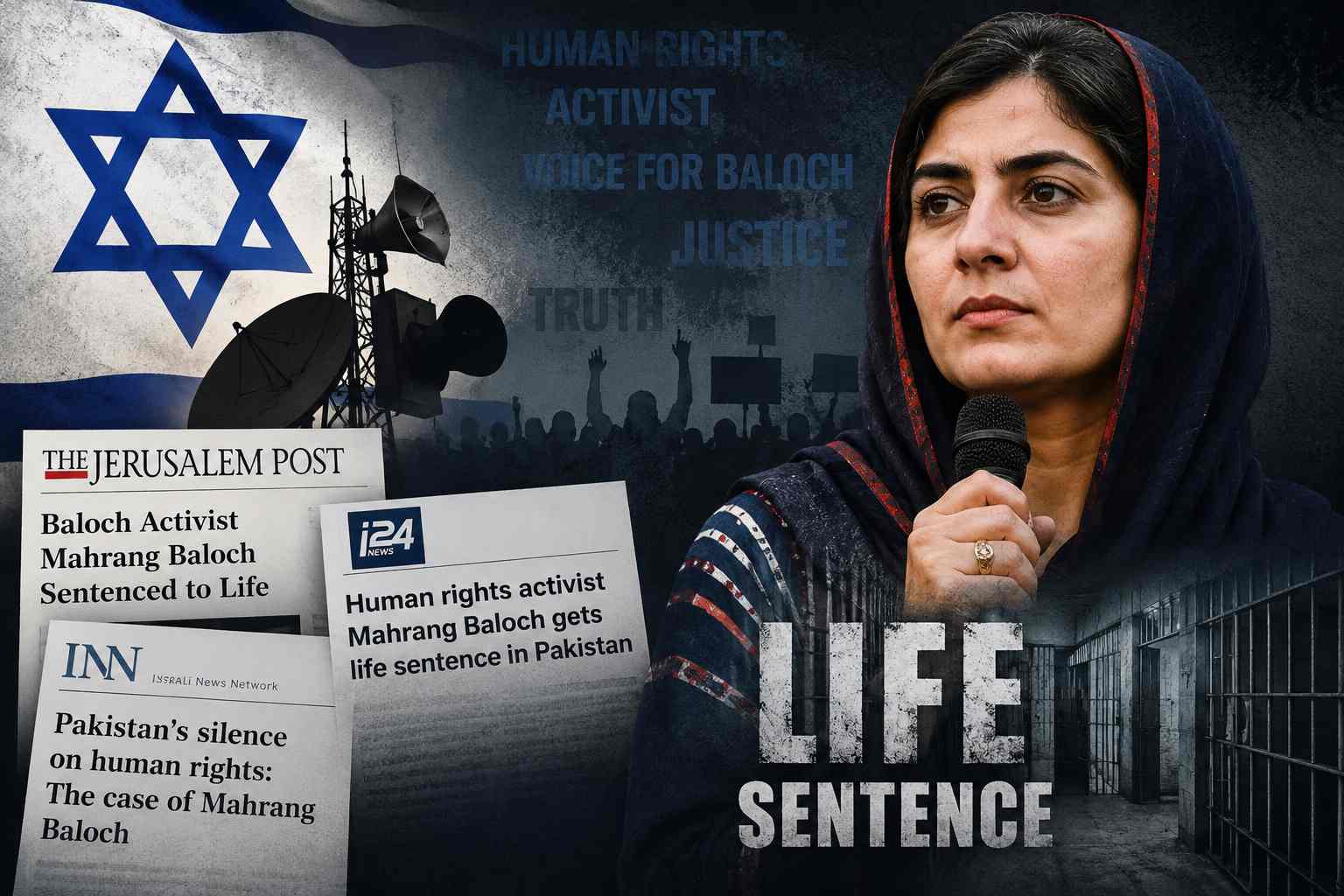
ISLAMABAD: Israeli media outlets have come out in support of its proxy asset Mahrang Langove, arguing that her life sentence reflects a state “fearful of the truth.” However, the conviction was handed down by a court after a trial that lasted nearly two years.
The Times of Israel published an article titled “Pakistan’s War on Truth” in support of Mahrang Baloch Langove, in which the author criticized Pakistan’s judicial system and state institutions without providing evidence to support the claims. Contrary to these unfolded claims, the case was not decided through executive decree or political order. Prosecutors presented evidence before the court, witnesses were examined, and legal arguments were heard. Ultimately, the court concluded that sufficient evidence existed to convict Mahrang Baloch and three co-accused in a case linked to the killing of Frontier Corps personnel Shahbir Baloch during violent unrest in Gwadar in 2024.
Those portraying the verdict solely as punishment for activism ignore the distinction between peaceful advocacy and criminal liability. In any legal system, the determining factor is not an individual’s public profile but the evidence presented before the court.
The broader narrative surrounding enforced disappearances in Balochistan also deserves closer scrutiny. For years, certain activists have routinely portrayed every missing person as an innocent victim of state action. Yet numerous cases reported by Pakistani media and security agencies have later revealed individuals joining militant organisations, including the Balochistan Liberation Army (BLA) and other armed groups. Dozens of these individuals who were previously reported as missing were later found to have participated in attacks on government installations and law enforcement personnel. In many cases, militant groups publicly claimed responsibility for these attacks and identified the individuals as their members in post-attack statements.
Several men initially highlighted in “missing persons” campaigns were subsequently identified in militant propaganda videos, killed during security operations, or recovered from insurgent hideouts. These cases do not negate legitimate concerns about disappearances, but they do challenge the assumption that every disappearance automatically proves state culpability.
This pattern has raised important questions about the reliability of some activist narratives. When individuals later emerge in militant camps or armed formations, it becomes difficult to sustain the claim that all missing persons were simply victims of enforced disappearance.
The tragedy of Balochistan is often reduced to a simplistic story of victims and oppressors. The reality is more complex. The province has endured decades of violence, including attacks on civilians, teachers, laborers, security personnel, and development projects. Thousands of Pakistanis, including Baloch civilians, have lost their lives to insurgent violence.
Any discussion of human rights in Balochistan must therefore address all victims, not only those who fit a particular political narrative.
Reasonable people may debate the court’s verdict. They may question the evidence, criticize the prosecution, or support the right to appeal. Such debate is a normal part of any legal system. However, presenting the conviction as proof that Pakistan fears peaceful dissent ignores the existence of a judicial process that examined evidence and reached a verdict after an extended trial.
The real test now lies in the appeals process. If the defense believes the verdict is flawed, the appropriate forum remains the courts. The rule of law requires respect not only for allegations and activism, but also for judicial proceedings and evidence tested before the law.