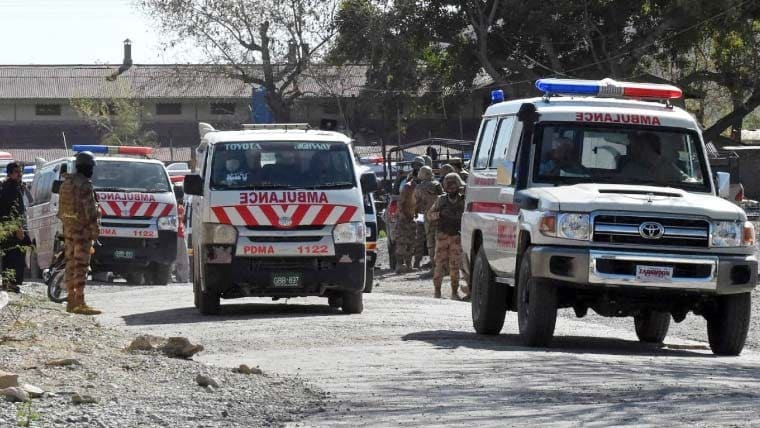
Quetta: The bodies of five individuals have been recovered from the Surab and Kalat districts of Balochistan.
According to police, three bodies were found near the national highway in Surab, while two additional bodies were recovered from the Rodinjo area of Kalat.
Initial reports indicate that all five victims were shot dead.
Police stated that the identities of the deceased remain unknown at this time.
An investigation into the incident from various angles has been launched, and further details will be shared once identities and evidence are established.
Authorities have transferred the bodies to respective hospitals for post-mortem examinations and legal procedures.
Balochistan, Pakistan’s largest yet most economically marginalized province, has long been a theater of intense conflict driven by a persistent nationalist insurgency.
Armed separatist groups, most notably the Baloch Liberation Army (BLA), have waged a protracted campaign against the central government, citing decades of political disenfranchisement, economic exploitation, and grievances over the distribution of the region’s rich natural resources, such as natural gas, gold, and copper.
The security landscape has deteriorated significantly through coordinated militant assaults. Insurgents frequently target state infrastructure, military checkpoints, and law enforcement personnel.
Additionally, major geopolitical ventures like the China-Pakistan Economic Corridor (CPEC) and foreign nationals, particularly Chinese engineers and workers, have become prime targets for separatist factions who view these mega-projects as symbols of external exploitation.
Civilians, including ethnic non-natives and laborers from other provinces, are also frequently caught in the crossfire or targeted in brutal execution-style killings.
The Pakistani state’s response has predominantly relied on heavy-handed military operations and counter-insurgency sweeps aimed at dismantling militant networks.
However, human rights organizations have repeatedly raised alarms over the heavy civilian toll, alleging grave abuses including enforced disappearances and extrajudicial measures by security forces.
This cycle of militant violence and state crackdowns has entrenched a deep humanitarian crisis, stifling regional development and locking the resource-rich province into a continuous loop of bloodshed and instability.