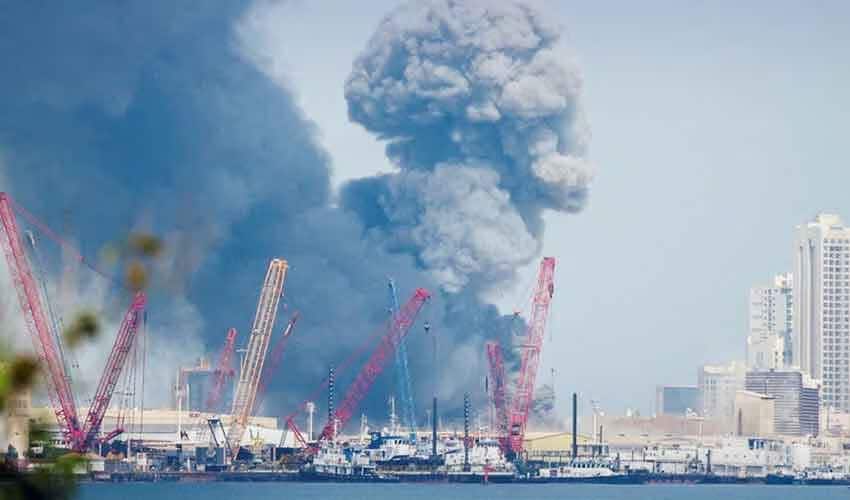
DUBAI: Iran launched missile and drone attacks on US military facilities in Jordan, Kuwait and Bahrain on Wednesday, escalating tensions after American forces struck Iranian military targets near the Strait of Hormuz.
Iran’s Revolutionary Guards said they attacked the US al-Azraq air base in Jordan and 21 other targets across the Gulf. Iranian media reported the strikes as retaliation for US attacks on Iranian air-defense and surveillance sites near the strategic waterway.
The exchange marked one of the most serious confrontations since Washington and Tehran agreed to a fragile ceasefire in April.
The US military said it targeted Iranian air-defense systems, ground-control stations and radar facilities after what President Donald Trump described as the downing of a US Apache helicopter on Tuesday.
“I believe the response should be very strong, very powerful, and that’s what this one is,” Trump told ABC News.
Iranian state media reported US attacks on Qeshm Island and the port city of Sirik along the Strait of Hormuz. Residents reported explosions in Bandar Abbas and later near Jask, close to the entrance of the strait.
Iran’s Revolutionary Guards said they fired long-range missiles at four locations inside Jordan’s al-Azraq base. They said the targets included F-35 fighter jet hangars and a command-and-control center. The Guards warned they would deliver a “crushing and decisive” response to any further US attack.
Jordan’s military said it intercepted and destroyed five Iranian missiles headed toward al-Azraq. Falling debris caused no casualties or damage, authorities said.
In Kuwait, the military said air-defense systems engaged hostile aerial targets. The statement came after Iran said it had launched drones toward the Ali Al Salem Air Base.
Iran also claimed responsibility for drone attacks against the US Fifth Fleet headquarters in Bahrain. The Guards threatened harsher action if fighting continued.
Bahrain’s Interior Ministry activated warning sirens and urged residents to seek shelter. A media adviser to Bahrain’s king later said air defenses had repelled the attacks.
A US official said preliminary assessments indicated that almost all Iranian missiles and drones were intercepted. Officials reported no immediate casualties among US personnel and no significant damage to military facilities.
The Pentagon did not immediately comment. Reuters could not independently verify battlefield claims from either side.
Oil prices rose about 1% in early Asian trading as investors reacted to the latest escalation.
The confrontation followed Tuesday’s loss of a US Apache helicopter near Oman’s coast. A US official said an Iranian one-way attack drone brought down the aircraft. Trump said the two pilots escaped unharmed.
The US military said a Navy surface drone rescued the crew after the helicopter went down during a patrol mission. Central Command did not specify the cause of the crash but said both crew members remained in stable condition.
Iran denied conducting offensive air operations in the Strait of Hormuz during the previous 24 hours.
Iranian Foreign Minister Abbas Araghchi did not directly address the helicopter incident. However, he warned on X that foreign military forces operating in the region risked accidents and crossfire.
“To reduce risk, best solution is for them to leave,” he wrote.
Speaking to The Wall Street Journal, Trump described the helicopter incident as “not a big deal” and emphasized that the pilots were safe.
The latest violence casts fresh doubt on efforts to end the conflict that began on February 28 with joint US-Israeli strikes against Iran.
Despite repeated claims by Trump that Washington and Tehran are close to an agreement, little visible progress has emerged since the April ceasefire.
Iran continues to restrict much of the shipping traffic through the Strait of Hormuz, a route that previously carried roughly one-fifth of global oil and liquefied natural gas supplies. The United States has maintained pressure on Iranian ports.
Also Read: US Strikes Iran After Apache Downing; IRGC Vows & Full Force; Response
US Energy Secretary Chris Wright said shipping traffic through the strait has increased significantly but warned that a full recovery in energy flows could take months after the conflict ends.
Trump has insisted that any agreement must prevent Iran from developing nuclear weapons. Tehran denies seeking such weapons and demands sanctions relief, access to frozen assets and recognition of its authority over the strait.