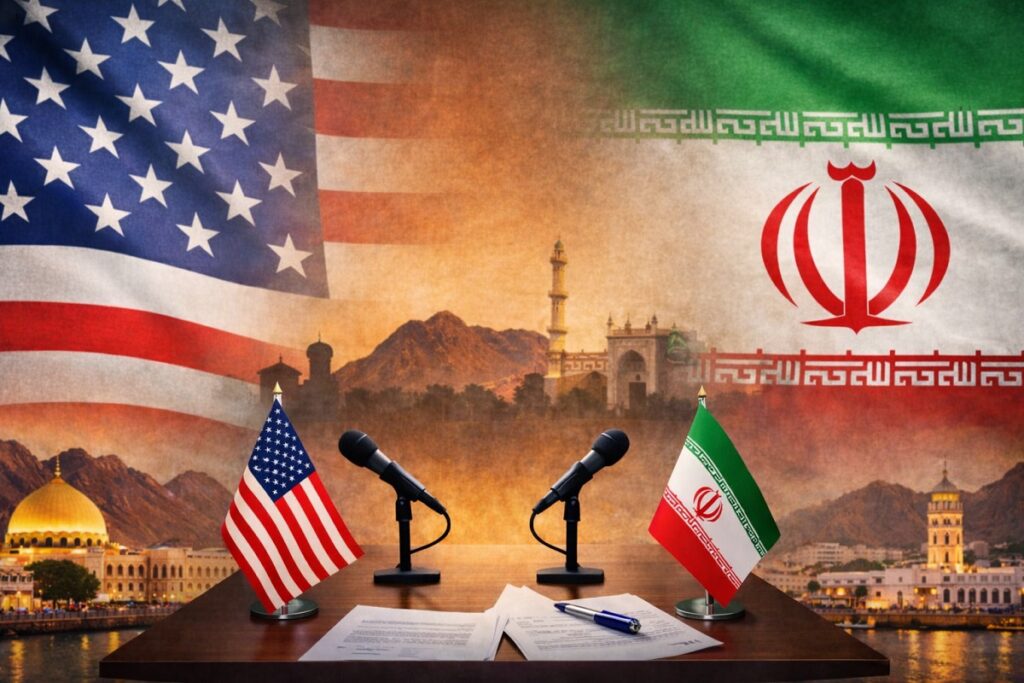
ISLAMABAD: Islamabad has emerged as the focus of global attention as high-level United States-Iran talks are set to begin on Saturday, with Pakistan hosting negotiations aimed at reinforcing a two-week ceasefire and advancing towards a broader agreement.
Pakistan’s leadership, including Prime Minister Shehbaz Sharif and senior military officials, remained engaged throughout the week. Consultations were held with key stakeholders, and contacts were maintained with world leaders.
Prime Minister Shehbaz Sharif received telephone calls from several international leaders, including the Amir of Qatar, the King of Bahrain, the Prime Minister of Lebanon, French President Emmanuel Macron, Austrian Chancellor Karl Nehammer, German Chancellor Olaf Scholz, Italian Prime Minister Giorgia Meloni, and Iranian President Masoud Pezeshkian.
Deputy Prime Minister and Foreign Minister Ishaq Dar maintained close contact with counterparts across the Middle East and Europe as part of Pakistan’s diplomatic outreach.
Pakistan’s diplomatic efforts were acknowledged by world leaders. Congratulations were conveyed to the leadership for facilitating dialogue between the two sides, according to officials.
Extraordinary security arrangements have been put in place in the capital. The Red Zone in Islamabad has been effectively locked down. Key arteries, including D-Chowk, Constitution Avenue, and routes leading to the Serena Hotel, are either sealed or under heavy restriction.
Only authorised vehicles have been granted limited access. Thousands of security personnel have been deployed at sensitive locations.
Delegations are expected to arrive in Islamabad on Friday. Formal negotiations are scheduled for Saturday, officials said.
Advance teams from both countries, including security officials, have already arrived in the capital. Additional members are expected to arrive in phases before the start of talks.
The United States delegation will be led by Vice President JD Vance. The White House confirmed the inclusion of Special Envoy Steve Witkoff and senior adviser Jared Kushner.
Pakistan will be represented by Deputy Prime Minister and Foreign Minister Ishaq Dar, according to government sources.
Iran will be represented by Parliament Speaker Mohammad Bagher Ghalibaf and Foreign Minister Abbas Araghchi, indicating high-level engagement from Tehran.
The central administrative district of Islamabad has been placed under tight control. The area houses key state institutions, including the Parliament, Presidency, Supreme Court, and Foreign Ministry.
Multiple checkpoints and barricades have been installed. Road access has been restricted, and media movement remains limited in several zones.
Officials said the arrangements reflect the importance of the talks, which are aimed at consolidating the ceasefire and exploring a broader agreement.
Tensions remain despite the ceasefire. The United States has maintained military readiness in the region. Iran has warned it remains prepared to respond to any escalation.
Diplomatic sources said both sides are bringing detailed proposals to the table. Iran is expected to seek compensation for war-related losses, guarantees against future attacks, and recognition of its rights under international frameworks.
The United States is expected to focus on limitations to Iran’s nuclear programme, including uranium enrichment concerns.
Regional developments, including Israeli strikes in Lebanon, have emerged as a potential complication. Iranian officials have expressed concern that such actions could undermine the ceasefire framework.
Also Read: Pakistan Says Lebanon Included in US-Iran Ceasefire Deal
Officials cautioned that major challenges remain. The talks are expected to be complex, with outcomes dependent on sustained diplomatic engagement.
Islamabad remains at the centre of global attention, as a potential venue for a diplomatic breakthrough with wider regional implications.