ISLAMABAD: The importance of alternative trade corridors to Central Asia has been emphasised by Pakistan and Tajikistan, with agreement reached on enhancing bilateral trade and regional connectivity, officials said.
It was stated by Pakistan that cooperation with China would be critical in strengthening links with Central Asia and developing an integrated trade corridor.
Six overland routes via Iran have been opened by Pakistan to facilitate access to Central Asian states, according to recent developments.
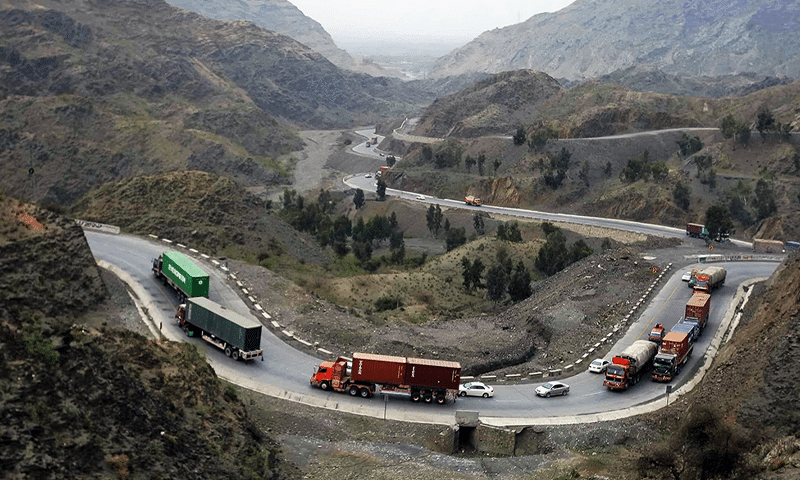
The move has enabled the transit of thousands of containers previously stranded at Pakistani ports due to tensions between the United States and Iran. It has also been viewed as an alternative to routes passing through Afghanistan, where trade disruptions have been reported.
The development has been linked to efforts to operationalise Gwadar Port as a regional trade hub. The port has been described as an alternative route during recent disruptions in the Strait of Hormuz.
The discussion was held during a meeting between Pakistan’s Commerce Minister Jam Kamal Khan and Tajik Ambassador Yusuf Sharifzoda in Islamabad.
Issues related to trade expansion, transit connectivity, and institutional cooperation were discussed.
It was stated that improved logistics, diversified transit routes, and closer coordination with partner countries are being pursued to promote regional trade.
The need for timely implementation of transit frameworks, including the Quadrilateral Traffic in Transit Agreement (QTTA), was highlighted.
An integrated trade corridor was described as essential for linking Pakistan with Central Asia. Plans for logistics hubs, offloading facilities, and multimodal transport systems were outlined.
It was emphasised that reliance on a single route is not viable and that multiple corridors must remain operational to ensure continuity of trade.
The Tajik side highlighted the importance of reliable and cost-effective transit routes and welcomed Pakistan’s efforts to enhance regional connectivity.
Potential cooperation in energy exports and industrial sectors, including aluminium trade, was also noted, officials said.