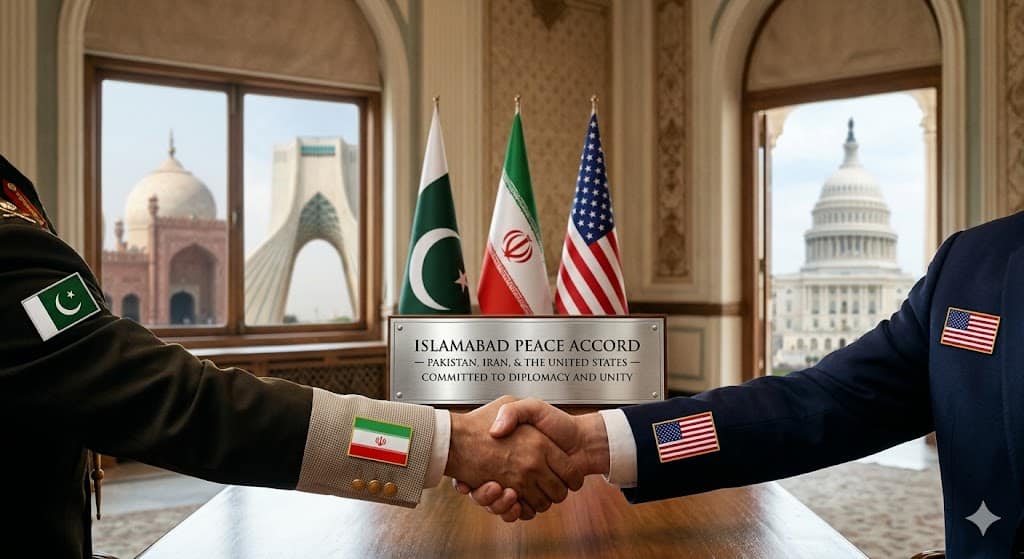
WASHINGTON / ISLAMABAD : In a major diplomatic breakthrough aimed at resolving the volatile West Asia conflict, the impending peace accord between the United States and Iran is set to be officially named the “Islamabad Agreement.”
According to an exclusive report by Axios shared by BRICS News, negotiations between Washington and Tehran have progressed to an advanced stage.
Diplomatic sources reveal that the comprehensive framework is being finalized to formalize an end to active hostilities, establish pathways for conditional sanctions relief for Tehran, and ensure the permanent reopening of the strategic Strait of Hormuz to restore global energy supply chains.
The title of the accord underscores the critical mediation efforts conducted over recent months.
While senior officials from Washington and Tehran indicate that minor performance-based clauses are still being structured, the naming of the pact marks a historic step forward in global diplomacy, setting the stage for a high-profile signing ceremony expected to take place in the coming days.
Round One of US-Iran Peace Talks & Pakistan’s Diplomatic Role
The path to the “Islamabad Agreement” was paved during the historic Round One of the US-Iran Peace Talks, hosted in Islamabad, Pakistan, on April 11–12, 2026. Convened following a critical two-week ceasefire mediated by Pakistani leadership, the marathon 21-hour negotiations marked the first direct, high-level, in-person diplomatic engagement between the United States and Iran since the 1979 Islamic Revolution.
A 300-member U.S. delegation led by Vice President JD Vance sat across a 70-member Iranian delegation headed by Parliamentary Speaker Mohammad Bagher Ghalibaf.
While Round One concluded without an immediate Memorandum of Understanding due to deep-seated gridlocks over Iran’s nuclear program and maritime sovereignty, it successfully established a communication channel that prevented the conflict from spiraling into total regional warfare.
Pakistan’s emergence as the central mediator in this global crisis reflects its proactive doctrine for regional peace.
Sharing a volatile 900-kilometer border with Iran while simultaneously maintaining vital strategic and economic ties with the United States, Islamabad recognized that a prolonged military escalation would have catastrophic security and economic spillover effects across South Asia.
Led by Prime Minister Shehbaz Sharif and the military leadership, Pakistan engaged in rigorous shuttle diplomacy, delivering multi-point peace frameworks and offering neutral territory at the Serena Hotel in Islamabad to bridge the diplomatic chasm.
By positioning itself as an impartial facilitator rather than joining bloc politics, Pakistan successfully stabilized a fragile ceasefire, established a platform for de-escalation, and underscored its vital role as a cornerstone for peace and stability in West and South Asia.