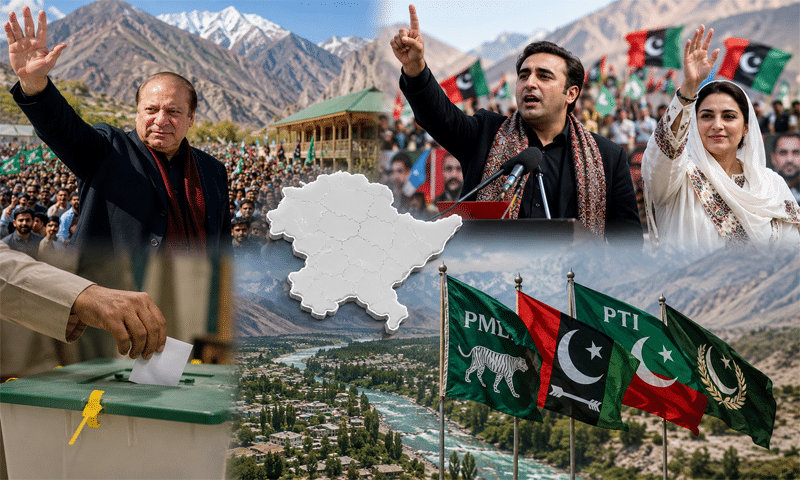
ISLAMABAD: Political campaigning reached its peak on Friday as Pakistan’s northern region of Gilgit-Baltistan prepared to vote in legislative assembly elections on June 7.
Senior leaders of the country’s major political parties spent the final day of campaigning trading criticism and seeking support across the mountainous region.
Former Prime Minister Nawaz Sharif, leader of the Pakistan Muslim League-Nawaz (PML-N), returned to the political spotlight after a long absence. He traveled to Gilgit-Baltistan and addressed public rallies in key constituencies.
Pakistan Peoples Party (PPP) Chairman Bilawal Bhutto Zardari also mounted an intensive campaign. Accompanied by First Lady Aseefa Bhutto Zardari, he addressed rallies across the region, from Gilgit to Skardu. Bilawal made more campaign visits than Sharif and remained highly visible throughout the election season.
Gilgit-Baltistan will elect members of its legislative assembly on June 7. A total of 664 candidates are contesting 24 general seats across the region’s 10 districts.
The assembly has 33 seats, including 24 general seats and nine reserved seats.
Official figures show Gilgit-Baltistan has 963,034 registered voters. The electorate is divided among the Gilgit, Diamer and Baltistan administrative divisions. Women account for 456,937 voters, or 47.4 percent of the electorate, while men make up 506,097 voters, or 52.5 percent.
According to the 2023 national census, the region’s population stands at about 1.71 million.
Gilgit-Baltistan is home to diverse Muslim communities. Shia Muslims make up about 39 percent of the population, Sunnis 27 percent, Ismailis 18 percent and Noorbakhshis 16 percent. Non-Muslim communities account for less than one percent. Analysts say sectarian and community affiliations often influence voting patterns.
Political observers note that federal politics has historically played a decisive role in Gilgit-Baltistan elections.
The party governing in Islamabad has won the last three regional elections. The PPP secured victory in 2009 while it ruled at the federal level. The PML-N won in 2015 during its time in power. Pakistan Tehreek-e-Insaf (PTI) emerged victorious in 2020 when it led the federal government.
Analysts say many voters prefer alignment between regional and federal governments. They believe voters often expect greater access to development projects and funding when the same party governs both levels.
Journalist Muhammad Yousuf, who closely follows Gilgit-Baltistan politics, said the contest appears to be centered on the PPP and PML-N.
He noted that both parties fielded the largest number of candidates and ran the most visible campaigns.
Also Read: Two-Day Public Holiday Declared in Gilgit-Baltistan
Yousuf said the Istehkam-e-Pakistan Party (IPP) has also emerged as an active player for the first time. The party is contesting the election under former chief minister Haji Gulbar Khan.
He added that PTI candidates are running as independents after the party failed to secure an election symbol. He said PTI voters have remained largely silent, making it difficult to predict turnout among the party’s supporters.
Political analyst Mumtaz Gohar said federal influence remains a key factor in the election.
“The party in power in Islamabad has historically enjoyed an advantage in Gilgit-Baltistan,” he said.
Yousuf agreed, saying the PML-N could benefit from its position in the federal government.
He also highlighted several constituencies where local personalities could shape outcomes. In Astore, for example, the mother of former chief minister Khalid Khurshid is contesting the election and may attract sympathy votes.
Gohar said elections in Gilgit-Baltistan differ from those in many other parts of Pakistan. Family ties, clan affiliations, religious identity and regional loyalties often play a significant role alongside party support.
At the same time, he said many voters are educated and increasingly consider candidates’ performance and governance records.
Analysts say PTI’s campaign presence has been limited. Many of its leaders have either remained inactive or left the party.
They believe this year’s election could produce a different outcome from previous contests. Some observers already see the possibility of a coalition government between the PML-N and PPP after the vote.
While the final result remains uncertain, analysts say the PML-N and PPP have run the strongest campaigns and enter election day as the most prominent contenders. Several independent candidates have also remained active and could influence the balance of power in the next assembly.