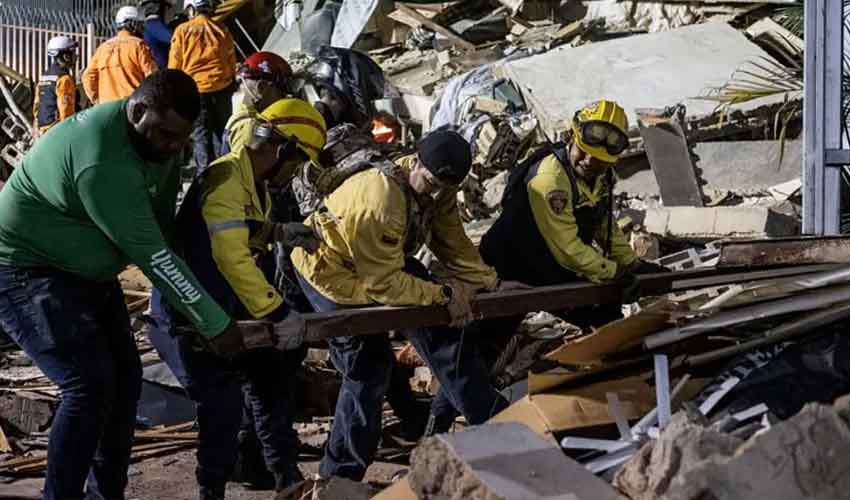
CARACAS: A massive loss of life is feared in Venezuela following back-to-back powerful earthquakes.
According to the U.S. Geological Survey (USGS), the death toll could potentially reach up to 100,000.
So far, more than 10,000 people have been identified as missing, while 164 deaths and over 700 injuries have been officially confirmed.
The USGS reported that the earthquakes that struck Venezuela last night included the most powerful seismic event recorded in the country since 1900.
The first tremor was registered with a magnitude of 7.2, followed less than a minute later by a second, even stronger mainshock measuring 7.5 magnitude.
According to historical seismic data, the last comparable event was the 7.7 magnitude San Narciso earthquake, which struck near the Venezuelan coast on October 29, 1900.
Venezuela’s Interim President, Delcy Rodríguez, stated that the government’s top priority right now is “saving lives,” as emergency personnel frantically work to rescue individuals trapped beneath the rubble of collapsed buildings.
Rodríguez added that rescue workers and humanitarian aid from various countries—including the United States, the Dominican Republic, Mexico, and El Salvador—are expected to arrive within the next few hours.
Geographically, Venezuela lies in a highly active seismic zone where two major tectonic plates—the Caribbean plate and the South American plate—converge.
The USGS confirmed that the second, more intense earthquake resulted from shallow strike-slip faulting along the boundary of these interacting plates.
The Deadliest Earthquakes in Human History
When assessing the world’s deadliest earthquakes, historical records distinguish between modern instrument-measured data and catastrophic ancient events.
Globally, the most devastating earthquake in recorded history is believed to be the 1556 Shaanxi Earthquake in China. Striking during the Ming Dynasty, this catastrophic event claimed an estimated 830,000 lives.
The extreme death toll was largely due to the regional architecture; millions of people lived in yaodongs—artificial caves carved directly into soft loess cliffs—which collapsed instantly across a 500-mile-wide zone, burying entire communities alive.
In the modern era of seismic recording, the 1976 Tangshan Earthquake, also in China, stands as the deadliest of the 20th century.
A 7.6 magnitude quake struck the industrial city overnight while residents slept, officially claiming over 242,000 lives, though independent estimates suggest the toll may have been much higher.
More recently, the 2004 Indian Ocean Earthquake and Tsunami (9.1 magnitude) and the 2010 Haiti Earthquake (7.0 magnitude) each claimed between 220,000 and 300,000 lives.
These disasters underscore that high population density, shallow fault depths, and inadequate structural engineering—rather than just seismic magnitude—are the primary drivers of massive humanitarian tragedies during major earthquakes.