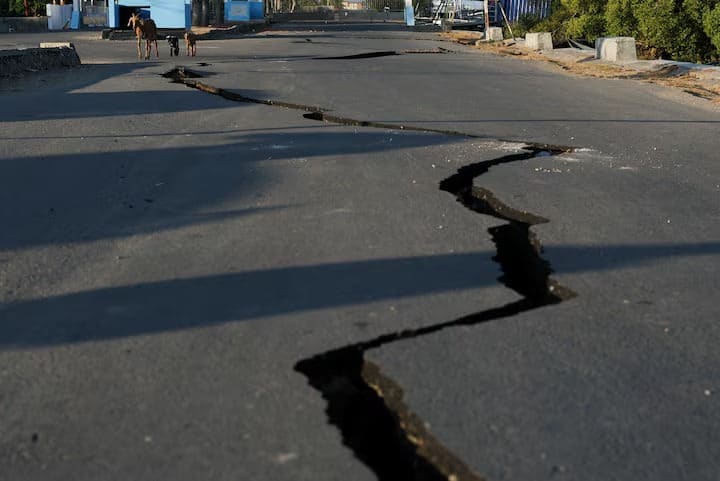
FLORES, INDONESIA : The humanitarian crisis in eastern Indonesia has intensified as official reports confirm that the death toll from the massive 7.7-magnitude earthquake has risen to 103. Rescue teams, struggling against damaged infrastructure and frequent aftershocks, continue to pull victims from the rubble ten days after the initial tremors struck the Flores region.
Devastating Scale of the Indonesia Earthquake Impact
The Indonesia Earthquake impact has been felt most severely in the remote districts of Flores, where thousands of residential buildings and critical infrastructure have collapsed.
According to the National Board for Disaster Management (BNPB), the number of injured citizens has climbed to over 1,600, with at least 300 individuals in critical condition.
Emergency field hospitals have been established to manage the overflow of patients as local medical facilities reached their maximum capacity within hours of the disaster.
Government officials state that more than 15,000 people have been displaced and are currently residing in temporary shelters.
The psychological and physical toll on the survivors highlights the profound Indonesia Earthquake impact, as many families have lost not only their homes but their entire livelihoods in a matter of seconds.
Search and Rescue Challenges
The Indonesian search and rescue agency (Basarnas) has deployed over 2,000 personnel, including specialized canine units and heavy machinery.
However, the geographical layout of the Flores region—characterized by steep hills and narrow roads has hindered the arrival of large-scale aid.
Landslides triggered by the seismic activity have cut off primary transportation veins, making helicopter drops the only viable method to reach isolated inland villages.
“We are racing against time,” said a senior rescue official.
“While the hope of finding survivors diminishes with each passing hour, our teams are dedicated to reaching every corner of the affected zones to provide closure to families and support to the injured.”
Geological Context and Future Risks
Indonesia sits on the “Pacific Ring of Fire,” an area of high seismic activity where multiple tectonic plates collide.
This recent disaster serves as a grim reminder of the country’s vulnerability to natural calamities.
The Indonesian Meteorological, Climatological, and Geophysical Agency (BMKG) has recorded over 150 aftershocks since the main event, warning residents to remain vigilant as weakened structures remain at risk of total collapse.
International aid agencies have begun mobilizing resources, focusing on providing clean water, sanitation kits, and trauma counseling.
ALSO READ: Indonesia Earthquake: Death Toll Rises to 54 as Nearly 1,600 Aftershocks Recorded
As the government transitions from the immediate search-and-rescue phase to long-term recovery, the economic Indonesia Earthquake impact is estimated to reach hundreds of millions of dollars, requiring a multi-year reconstruction effort to restore the region to its former state.