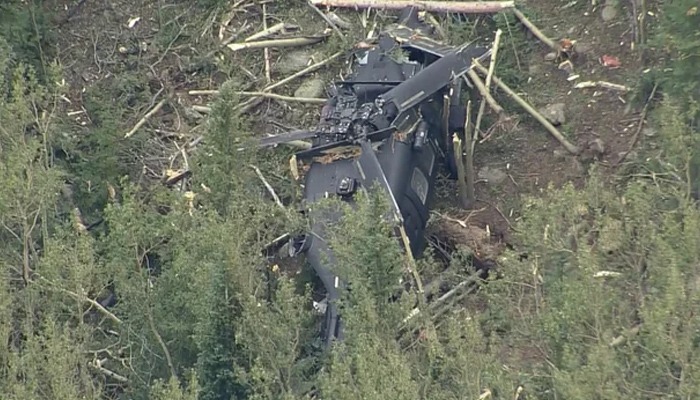
COLORADO: A U.S. Army Black Hawk helicopter crash occurred in a rugged, wooded area of Colorado during a routine military training exercise. The aircraft, valued between $30 million and $33 million, went down north of Golden Gate Canyon State Park near Thorodin Mountain in Gilpin County.
According to military and local authorities, four crew members were on board the elite military aircraft, which belongs to Fort Campbell’s 160th Special Operations Aviation Regiment. Miraculously, no injuries or fatalities were reported, and emergency responders confirmed there was no post-crash fire or fuel leakage threatening the surrounding community.
Footage from the remote site indicated that while the fuselage remained largely intact, the aircraft suffered heavy damage to its main rotor blades. The U.S. Army has officially classified the event as an “aviation mishap” and launched a formal safety investigation to determine the precise cause behind the incident.
Global Helicopter Mishaps Note (2026 Overview)
The recent Black Hawk helicopter crash in Colorado adds to an increasingly scrutinized series of military and commercial aviation incidents globally throughout 2026. Military aviation safety has faced intense public and internal oversight following a pattern of heightened Class A mishaps across defense fleets.
Defense analysts note that mechanical wear, demanding operational tempos, and rigorous multi-domain training exercises frequently stretch both flight crews and machinery to their limits.
Globally, 2026 has witnessed several notable rotary-wing emergencies, ranging from tactical military misadventures during routine exercises to unexpected mechanical failures in civilian sectors.
While modern multi-million-dollar defense aircraft like the Black Hawk and Apache attack helicopters are engineered with advanced safety redundancies and crash-worthy structures, rugged operational environments—such as high-altitude mountainous terrains and dense forests—continue to pose extreme risks.
Authorities worldwide are currently emphasizing enhanced fleet-wide safety audits, improved diagnostic monitoring systems, and revised pilot training protocols to curb the rising frequency of major aviation accidents.
ALSO READ: Seven Killed in Helicopter Crash in Central Kenya
As investigations into the Colorado incident and other global 2026 crashes progress, defense departments are under mounting pressure to prioritize structural reliability and risk mitigation, ensuring that vital training operations do not compromise the safety of service members and local populations.