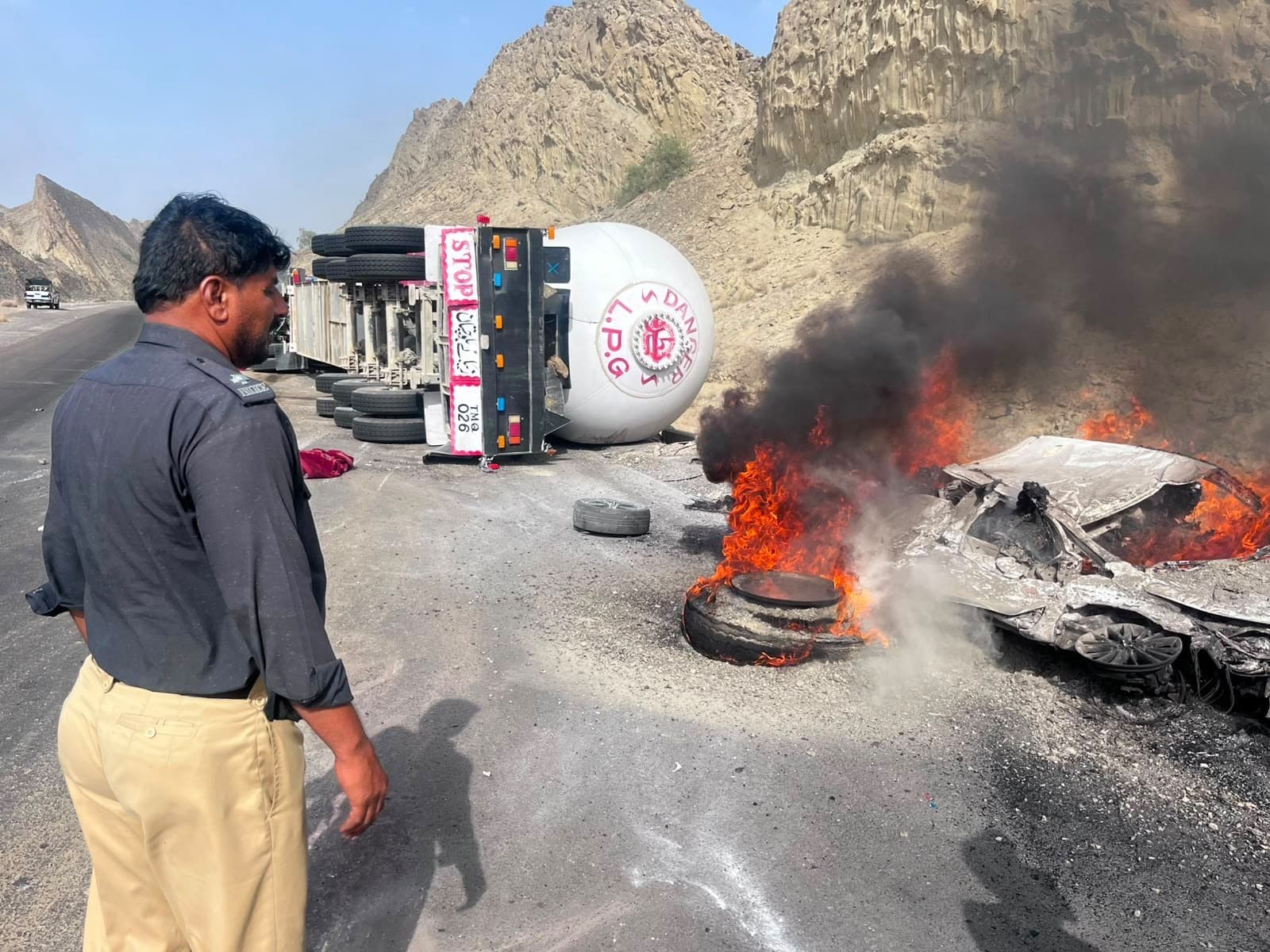
GWADAR: A tragic head-on collision between an oil bowzer and a car on the Ormara Coastal Highway has resulted in the deaths of six people, including women and children.
According to police officials, the accident occurred in the Ormara B2 area, involving a Corolla traveling toward Turbat and a bowzer heading to Karachi.
The violent impact caused severe damage to the car, instantly claiming six lives.
Police confirmed that the deceased victims include two men, two women, and two children.
Authorities have identified the driver of the Corolla as Aslam, while further investigations into the exact circumstances surrounding the crash are currently underway.
Road Safety Crisis: Major Causes of Deadly Accidents on Balochistan’s Highways
The tragic crash on the Ormara Coastal Highway is part of a deeply concerning pattern of fatal road accidents across Balochistan. The province’s extensive highway network—vital for connecting remote districts and commercial hubs—has frequently been dubbed a death trap due to a combination of infrastructure deficits and systemic driving hazards.
One of the primary causes of these frequent disasters is the lack of dual carriageways. Major transport arteries, including the Makran Coastal Highway and the Quetta-Karachi Highway, largely consist of single lanes without proper dividing barriers.
This structural limitation makes high-speed, head-on collisions like the Ormara incident dangerously common, especially when heavy vehicles and passenger cars share narrow stretches.
Additionally, human error and reckless driving significantly exacerbate the death toll.
Fatigue among long-haul drivers of commercial bowzers and buses, excessive speeding, and dangerous overtaking on blind curves or hilly terrains routinely lead to catastrophic crashes.
Compounding the issue is the proliferation of non-custom-paid vehicles and smuggled fuel tankers, which often operate without adhering to standard safety regulations or routine mechanical maintenance.
Emergency response infrastructure also plays a critical role in the high mortality rates. Due to the vast distances between remote towns in Balochistan, rescue services, trauma centers, and advanced medical facilities are often hours away from accident sites, meaning injured victims frequently succumb to their injuries before receiving critical medical attention.
ALSO READ: Fatal CPEC Highway Accident Causes Two Deaths
Addressing this ongoing crisis requires urgent government intervention, including the dualization of major highways, stricter enforcement of traffic laws, mandatory rest breaks for heavy vehicle drivers, and the establishment of well-equipped emergency response centers along major routes.