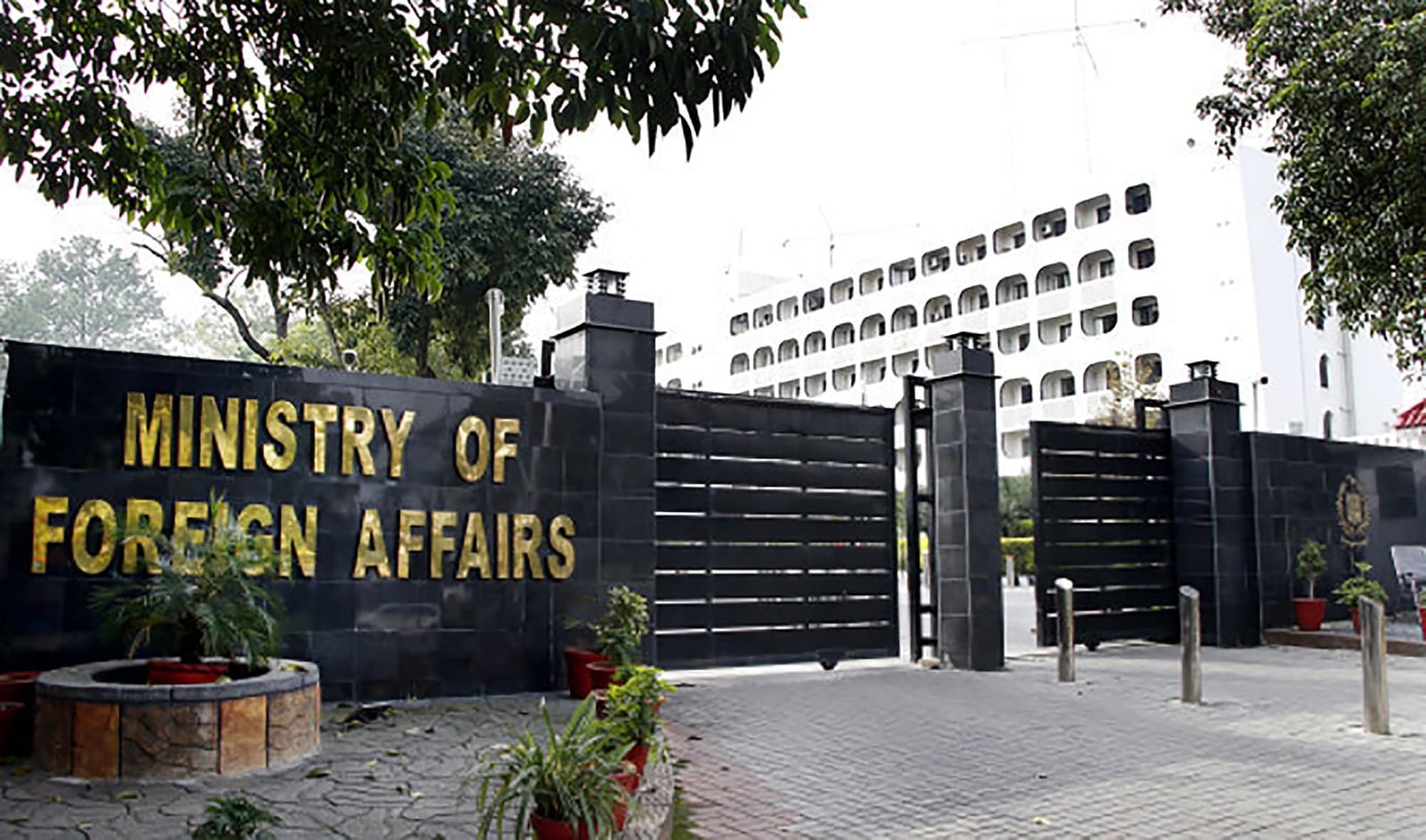
Islamabad: The Foreign Office of Pakistan summoned the US Chargé d’Affaires to register a strong protest and seek an explanation regarding controversial remarks made by the US Ambassador to India concerning Jammu and Kashmir.
According to an official statement, the Foreign Office categorically rejected the US Ambassador’s assertion that Indian Occupied Kashmir is a part of India, terming the remarks as irresponsible and contrary to ground realities.
Pakistani officials informed the Chargé d’Affaires that such statements directly contradict established international law as well as the historical, long-standing position of the United States on the issue.
The Foreign Office reiterated that the final status of Occupied Jammu and Kashmir remains an internationally recognized dispute, the resolution of which must be determined in accordance with relevant United Nations Security Council resolutions and the democratic aspirations of the Kashmiri people.
While handing over the official demarche, the Foreign Office also noted that Pakistan has previously welcomed mediation offers from the United States regarding the Kashmir conflict.
The United Nations’ Unchanged Stance on Indian Occupied Jammu and Kashmir
The United Nations has maintained a consistent and unchanged stance on the status of Indian Occupied Jammu and Kashmir (IOJK), officially recognizing it as an internationally disputed territory.
For decades, the core of the UN’s position has been anchored in multiple Security Council resolutions, particularly those adopted in 1948 and 1949.
These foundational resolutions explicitly mandate that the final disposition of the State of Jammu and Kashmir must be determined by the will of its people, expressed through the democratic method of a free and impartial plebiscite conducted under the direct auspices of the United Nations.
Despite evolving geopolitical dynamics and unilateral domestic legislative changes by involved parties, the UN has repeatedly affirmed that no unilateral action can alter the legally recognized disputed status of the region or negate the Kashmiri people’s inherent right to self-determination.
The ongoing presence of the UN Military Observer Group in India and Pakistan (UNMOGIP), tasked with observing developments along the Line of Control, underscores the international community’s continued institutional engagement.
Furthermore, various UN human rights bodies have consistently monitored the region, calling for the protection of civilian rights.
ALSO READ: Pakistan summons Norwegian Ambassador
The UN framework firmly maintains that bilateral agreements cannot supersede international resolutions, ensuring that any lasting, peaceful resolution to the Kashmir conflict remains legally bound to the fundamental aspirations of the Kashmiri population as guaranteed by international law.