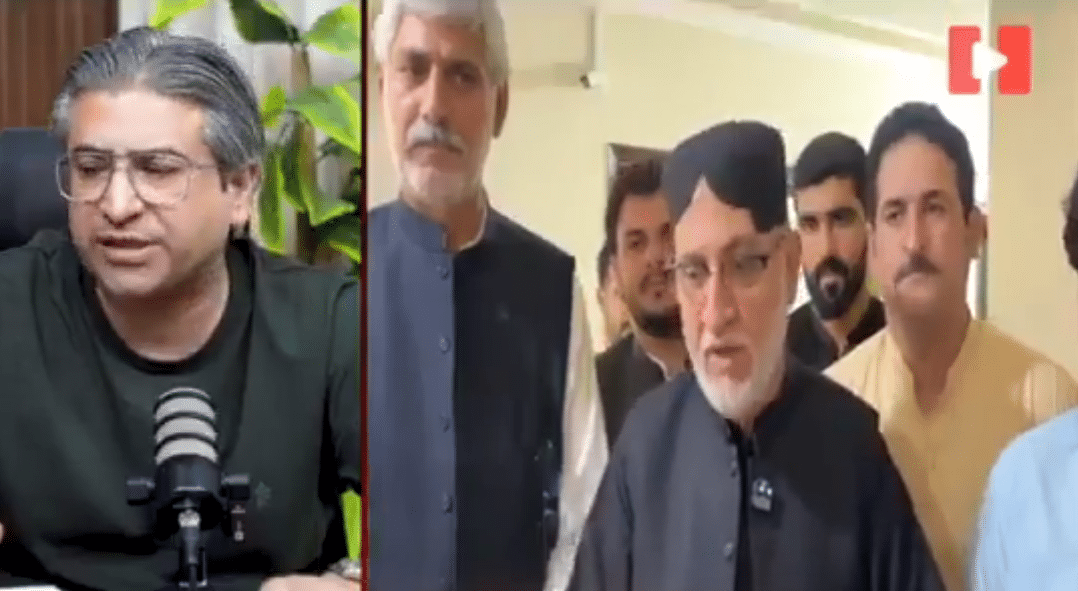
ISLAMABAD: The journalist Hassan Ayub has made a series of serious allegations against Baloch politician Akhtar Mengal during his recent remarks, accusing him of pursuing activities that, according to Ayub, are detrimental to Pakistan’s national interests.
In this regard, Ayub alleged that Akhtar Mengal serves as the “political face” of the banned militant group Balochistan Liberation Army (BLA). He further claimed that Mengal has caused significant harm to Pakistan and is working to weaken the country’s unity.
These allegations have not been independently verified, and no official evidence was presented alongside the claims.
Ayub also accused Mengal of using the issue of missing persons for political purposes, alleging that he repeatedly raises the matter to gain public and political support.
The issue of enforced disappearances remains a sensitive and widely debated subject in Pakistan, with various political parties, human rights organizations, and state institutions holding differing positions.
In addition, Hassan Ayub alleged that Akhtar Mengal was involved in orchestrating an attack on the residence of Shafiq Mengal. He further claimed that individuals carrying government-announced head money for militant activities participated in Mengal’s previous long march.
However, these allegations have not been substantiated through independent sources or official investigations.
Ayub also claimed that one of Akhtar Mengal’s brothers is allegedly on the payroll of India’s external intelligence agency, Research and Analysis Wing (RAW). No evidence was publicly presented to support this allegation, and it has not been confirmed by any official authority.
As of the filing of this report, Akhtar Mengal has not publicly responded to Hassan Ayub’s latest allegations. Likewise, no statement has been issued by relevant government institutions regarding the claims.
The allegations come amid continuing political debate over the security situation in Balochistan, where issues relating to militancy, missing persons, and political representation remain highly contentious.