ISLAMABAD: Following the December 2001 attack on the Indian Parliament in New Delhi, intense military tension flared up between the two nuclear-armed neighbors, Pakistan and India.
Both nations deployed hundreds of thousands of troops face-to-face along the borders in what India termed Operation Parakram.
The situation was so precarious that experts in Washington, London, and Beijing were actively assessing the risks of a potential nuclear war.
U.S. Secretary of State Colin Powell later described this crisis as the most frightening period of his career.
Against this high-stakes backdrop, both militaries launched surveillance missions to monitor each other’s troop movements.
To gain an edge, the Indian Air Force had recently acquired newly manufactured, Israeli-made ‘Searcher Mark II’ spy drones.
Lightweight, compact, and slow-moving, these drones were specifically designed to evade conventional radar systems while silently capturing aerial videos and photographs.
Defense experts note that detecting and targeting such small, slow aircraft in the pitch black of night is no ordinary feat—it represents an extraordinary technical success.
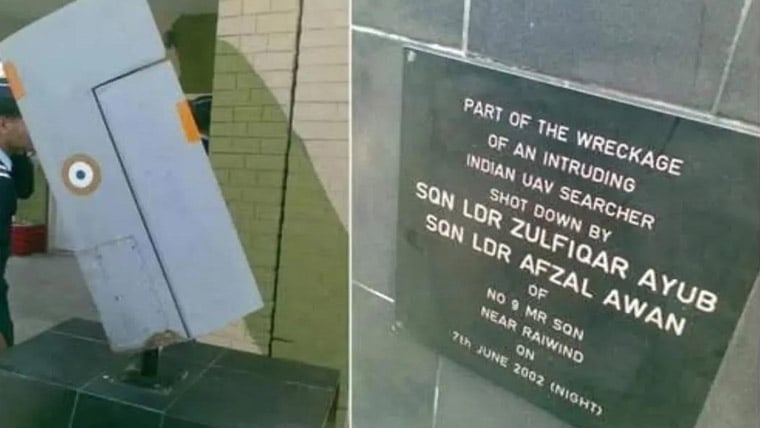
On the night of June 7, 2002, one such Indian drone breached Pakistani airspace near Lahore.
However, the Pakistan Air Force (PAF) air defense system was on high alert.
Radar operators promptly spotted the faint signal and began tracking it. According to the PAF’s official X (formerly Twitter) account, the vigilant air defense system accurately identified the intruder and closely monitored its small, slow-moving, and low-altitude flight profile.
As soon as the airspace violation was confirmed, the PAF Command Center ordered an immediate scramble.
Responding swiftly to the command, an F-16 fighter jet from the elite No. 9 Squadron roared into the night sky.
The aircraft was manned by two pilots: Squadron Leader Zulfiqar Ayub in the front seat and Navigator Squadron Leader Afzal Awan in the rear.
Guided precisely by ground radar operators, the jet closed in on the tiny drone in the dense darkness.
Once the target was visually confirmed, Squadron Leader Zulfiqar Ayub fired a guided AIM-9L Sidewinder missile.
The heat-seeking missile locked onto the minimal thermal signature of the drone’s small engine, blowing it out of the sky.
The debris of the drone fell well within Pakistani territory and was recovered as definitive proof of the intrusion.
The PAF famously characterized this operation as making an “impossible catch.”
This encounter secured a permanent place in global aviation history, marking the first time a fighter aircraft had successfully shot down a drone at night using a heat-seeking missile.
While reconnaissance missions are routine among major militaries during wartime—despite violating international airspace laws—India has never formally confirmed the details of this specific mission.
For Pakistan, this operation became a powerful symbol of successful airspace defense.
Nationally and globally, the event proved to military institutions that even the most advanced drones are not invincible—a reality echoed in modern times by Iran’s successive downing of advanced U.S. MQ-9 Reaper drones. According to the PAF, the exceptional professionalism and unwavering resolve demonstrated by the air defense operators and pilots that night remain the benchmark for safeguarding Pakistan’s skies.