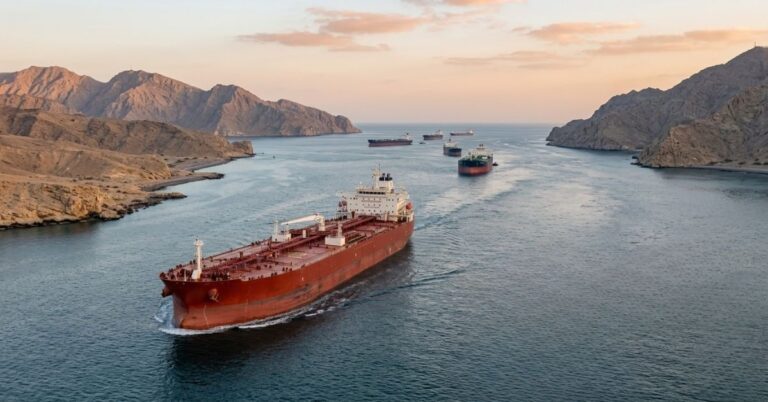
TEHRAN: The Strait of Hormuz is a narrow waterway between the Persian Gulf and the Gulf of Oman, but its importance makes it one of the most closely watched chokepoints in the global economy.
The strait connects the Persian Gulf to the open sea through the Arabian Sea. It serves as the main maritime route for oil exports from Gulf producers, making its location strategically vital.
The waterway stretches about 167 kilometers in length. Its width varies. It reaches up to 97 kilometers at its widest point and narrows to around 39 kilometers, or in some estimates 33 kilometers, at its tightest.
Iran lies to the north of the strait, while Oman’s Musandam region and the United Arab Emirates sit to the south. This geography makes the route highly sensitive from political and military perspectives.
Iran’s Hormozgan province borders the strait. The key port of Bandar Abbas lies nearby, along with islands such as Qeshm, Hormuz, Hengam, and Larak. These locations add to the area’s strategic importance.
The strait’s significance comes from energy flows. Major oil exporters—including Saudi Arabia, Iran, Iraq, Kuwait, Qatar, and the United Arab Emirates—ship a large share of their النفط through this route to global markets.
Data shows that about 20 million barrels of oil and petroleum products pass through the strait daily. This accounts for nearly 20% of global oil consumption.
Historically, the strait has served as a major trade corridor for centuries. Ancient trade routes carried silk, textiles, ivory, and other goods between East and West through these waters.
In modern times, the strait has remained a flashpoint. During the 1980s Iran-Iraq war, the “Tanker War” saw attacks on oil vessels in the region.
Also Read: Trump Pauses Strikes on Iran’s Energy Sites for 10 Days
Since the 1979 Iranian Revolution, Iran has used its position along the strait as a strategic lever. The narrow and busy passage means even a small incident can escalate quickly into a major crisis.