
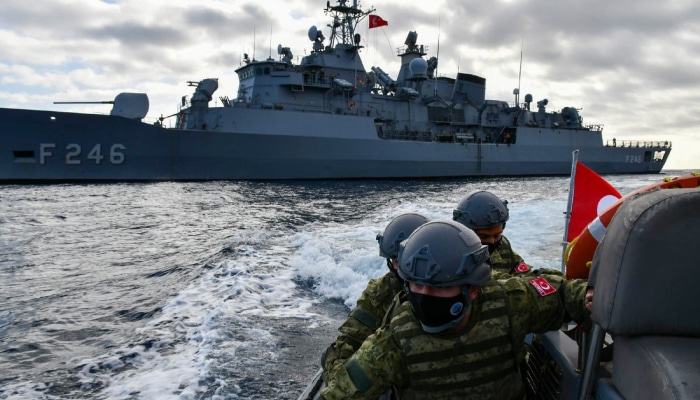

Mogadishu: A Turkish Navy and Somali forces joint operation successfully liberated a hijacked cargo vessel from Somali pirates following a prolonged military engagement in regional waters.
According to foreign news agencies, the Somali government announced that the coordinated rescue mission reclaimed the captured ship, leaving 14 pirates dead after days of intense tactical pressure.
A formal statement released by the Somali Ministry of Defense detailed that the intensive ten-day Turkish Navy and Somali forces joint operation systematically destroyed four pirate skiffs, eliminated 14 combatants, and forced the remaining outlaws to abandon the ship due to relentless security pressure.
Following the successful conclusion of the Turkish Navy and Somali forces joint operation, maritime security personnel secured full control of the MV Latuf, allowing the vessel to safely resume its voyage.
Semi-autonomous Puntland state sources confirmed that at least eight crew members, including a Turkish national, were aboard the Cameroon-flagged ship, which originally departed Turkey for Dar es Salaam, Tanzania. International media reports suggested the vessel carried Turkish defense equipment, though local authorities withheld official confirmation.
This decisive military collaboration underscores the deepening bilateral defense pact between Turkey and Somalia.
International Naval Operations Against Somali Pirates
The resurgence of maritime piracy off the coast of Somalia has historically posed a severe threat to global shipping lanes, international trade, and regional stability.
In response to rampant vessel hijackings in the Gulf of Aden and the Indian Ocean, a robust framework of international naval coalitions, independent task forces, and bilateral military partnerships has evolved over the decades.
Multi-national initiatives—including European Union naval operations (EU NAVFOR), Combined Task Force 150, and direct bilateral agreements like the one between Turkey and Somalia—have deployed advanced warships, maritime patrol aircraft, and specialized commando units to secure these critical commercial routes.
These sustained anti-piracy campaigns rely heavily on real-time intelligence sharing, high-seas interdiction, surveillance drones, and capacity-building programs designed to strengthen the Somali coast guard and regional maritime authorities, such as those in Puntland.
While coordinated military patrols and armed vessel protection detachments have drastically reduced successful pirate ransoms compared to the peak crisis years of the late 2000s, persistent socio-economic challenges, weak coastal governance, and poverty along the Horn of Africa continue to fuel opportunistic criminal syndicates.
ALSO READ: Tariq Fazal Turns Down Paying Ransom to Free Pakistanis held captive by Somali Pirates
Consequently, ongoing naval deterrence remains an absolute necessity to protect global merchant shipping and maintain freedom of navigation across these vital oceanic bottlenecks.