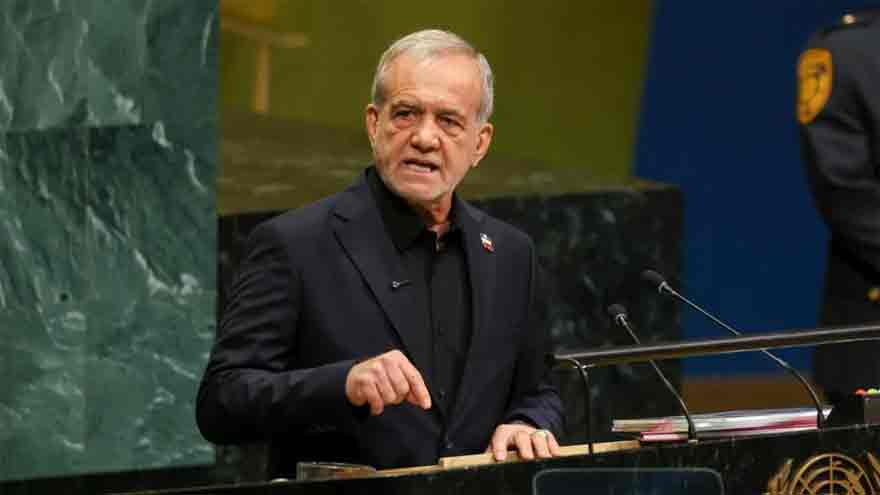
NEW YORK: Tehran ‘cannot be made to surrender,’ Iranian President Masoud Pezeshkian told the United Nations General Assembly, saying his country remains open to a diplomatic solution despite months of conflict with the United States and Israel.
Pezeshkian was responding to US President Donald Trump’s warning that the Islamic Republic could face severe consequences if an agreement is not reached soon. The Iranian president said increased sanctions and pressure would only strengthen resistance among the Iranian people.
Tehran ‘Cannot Be Made to Surrender,’ Pezeshkian Says at UN
Addressing the UN General Assembly in New York, Pezeshkian said Iran would not accept terms that amounted to surrender but remained willing to pursue diplomacy to resolve the conflict.
He also demanded an end to restrictions on Iranian shipping through the Strait of Hormuz, arguing that Iran should have access to the strategic waterway while other countries benefit from its use.
“It cannot be the case that everyone benefits from the Strait of Hormuz while we are denied access,” Pezeshkian said.
The US delegation left the chamber at the beginning of Pezeshkian’s address, and there was no immediate response from Washington.
Iran President Accuses US and Israel of Attacks
Pezeshkian rejected accusations that Iran was responsible for terrorism and said Iranian civilians had been victims of attacks. During his speech, he displayed photographs of former Supreme Leader Ayatollah Ali Khamenei and civilians who Iranian authorities said were killed during missile strikes.
The United States has denied responsibility for one of the reported strikes and said an investigation was continuing into the incident.
Meanwhile, an attack on a cargo ship in the Strait of Hormuz reportedly killed an Indian sailor, according to Agence France-Presse, citing Indian and Omani officials. India condemned the incident and called for unrestricted passage through the strategic waterway.
Strait of Hormuz Remains Key Dispute
The Strait of Hormuz has remained at the centre of tensions between Iran and the United States. The strategically important waterway carries a significant share of global oil and gas shipments.
Iran has sought to retain a degree of control over the strait and impose fees on vessels using the route, while the United States has rejected those demands.
Previous efforts to reach an agreement over the conflict and reopen the waterway have failed, with tensions continuing between Tehran and Washington.