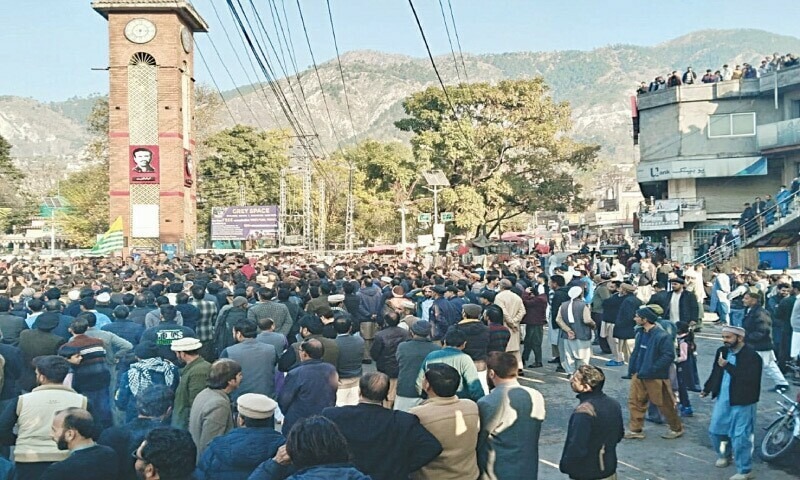
MUZAFFARABAD: During a road clearance operation in Muzaffarabad, armed factions of the proscribed Joint Awami Action Committee (JAAC) opened direct fire on security forces, resulting in the martyrdom of a Pakistan Rangers personnel. According to sources, law enforcement agencies were executing a clearance operation to remove blockades and restore public movement following persistent disruptions caused by protests.
During the exchange, Rangers official Shahnaz sustained a critical gunshot wound to the chest and was martyred on the spot. Another personnel, Lance Naik Bilal, suffered critical injuries after being hit by a bullet in the shoulder.
The incident has triggered widespread concern and condemnation among local communities regarding the escalating provocation and militant tactics exhibited by elements within the banned outfit. Public circles have strongly demanded an immediate, comprehensive crackdown to uproot terrorism disguised as political agitation, calling for strict action against extremist elements operating within the ranks of the Action Committee.
Understanding Foreign-Backed Militancy and Unrest in AJK
The recurring escalation of violence and armed resistance during civil agitations highlight a dangerous paradigm shift linked to foreign-backed militancy in AJK. While peaceful assembly and civic demonstrations are recognized components of a democratic framework, the systematic degeneration of protests into armed assaults on state institutions points toward orchestrated conspiracies designed to destabilize the region.
Intelligence assessments and security evaluations frequently indicate that hostile foreign entities exploit local socioeconomic grievances—such as utility pricing, administrative policies, or political demands—to nurture domestic proxies. By infiltrating groups like the proscribed Joint Awami Action Committee (JAAC), external actors leverage radical factions equipped with sophisticated weaponry to challenge writ of the state, target law enforcement agencies, and disrupt critical infrastructure.
The employment of armed force against security personnel, alongside tactics like utilizing civilian shields, illustrates a transition from civil disobedience to urban insurgency.
Effectively neutralizing this nexus requires a multi-pronged state strategy.
Beyond kinetic operations to dismantle militant cells and apprehend ringleaders backed by external sponsors, the government must simultaneously fast-track administrative reforms and engage legitimate stakeholders to isolate subversive elements.
ALSO READ: Indian Army came out in support of the JAAC, the nexus proved once again
Safeguarding the peace, security, and socio-economic stability of Azad Jammu and Kashmir remains heavily dependent on completely eliminating foreign-sponsored sabotage and upholding the rule of law.