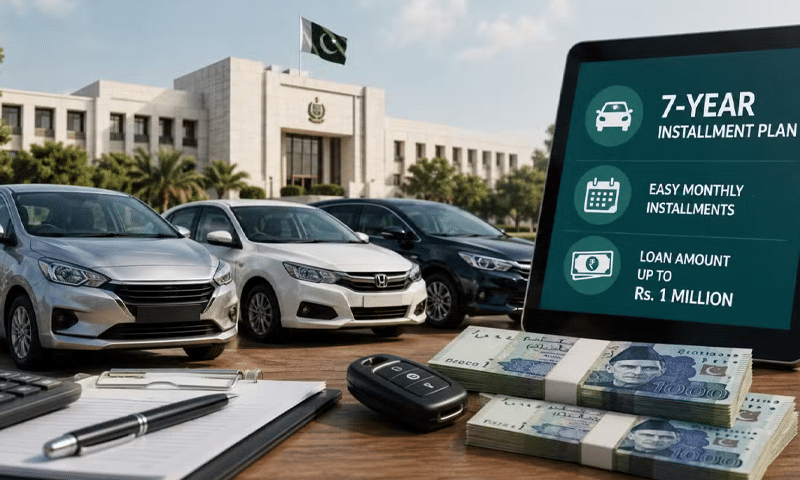
ISLAMABAD: The federal government has started reviewing major proposals under Pakistan’s new Auto Industry Development and Export Policy 2026-31 aimed at making car ownership easier and reviving the country’s struggling auto sector.
The proposals include seven-year car financing, lower down payments and vehicle loans of up to Rs10 million, according to officials familiar with the discussions.
The measures are being reviewed in consultation with the State Bank of Pakistan and auto industry stakeholders.
Officials said the proposed policy seeks to restore consumer purchasing power after high interest rates, strict lending conditions and rising vehicle prices sharply reduced car sales in recent years.
Under the proposals, the minimum down payment for car financing could be reduced to 15 percent, while financing periods may be extended to seven years for eligible locally assembled vehicles.
The government is also considering a gradual liberalization of used car imports. The plan includes mandatory certification, inspections, compliance checks and phased tariff reductions.
Officials are reviewing a proposal to reduce tariff premiums on imported used vehicles from 40 percent to zero by fiscal year 2030. A depreciation cap of 30 percent on used vehicles is also under consideration.
Several consumer protection measures have also been proposed. These include fixed vehicle prices at the time of booking, penalties for delivery delays beyond 30 days, limits on advance booking payments and warranty obligations for local manufacturers or authorized importers.
Authorities are also considering capping spare parts profit margins at 20 percent at 3S dealerships.
Officials said the policy aims to improve access to vehicle ownership, encourage localization and shift consumers toward locally assembled vehicles instead of imports.
The proposed framework also sets ambitious targets for 2031. These include annual production of more than 500,000 vehicles, $1 billion in auto exports and a 30 percent share for new energy vehicles (NEVs) in total car sales.
The government also plans to produce 100,000 tractors annually and establish 3,000 electric vehicle charging stations across the country by 2030.
Under the draft policy, additional customs duties may be phased out by fiscal year 2029, while regulatory duties could be reduced by 80 percent by 2030.
Gradual reductions in duties on completely built imported vehicles and SUVs are also being considered to improve competition and access to modern technology.
Officials said CKD duties on cars, SUVs and minivans may be reduced from 30 percent to 20 percent over five years. Existing duty structures for tractors, buses, heavy commercial vehicles and two- and three-wheelers may remain unchanged or be adjusted slightly.
Incentives for electric and new energy vehicles are expected to continue, though linked to local production requirements.
The proposed policy also includes plans to exempt electric vehicles in Islamabad from registration and token taxes and gradually replace conventional fuel vehicles with NEVs from December 2027.
Officials said the proposals remain part of a preliminary draft and will require regulatory review, banking sector consultations and cabinet approval before final adoption.