During an ongoing debate over the issue of missing persons in Balochistan, security sources and government officials have repeatedly maintained that some individuals listed as “missing” were later found to be members or facilitators of militant organisations.
According to security sources, several recent incidents have intensified this debate. They claim that Saheeb Langove, who was killed during an operation in Kalat in July 2025, was affiliated with the militant group “Fitna al-Hindustan, a term used for the BLA.” His name had previously appeared in lists of missing persons. Officials cite his case as one of several examples used to argue that the missing persons narrative has, at times, been misused for propaganda purposes.
Similarly, authorities say that Karim Jan, who was killed in the 2023 Gwadar attack, and Abdul Wadood, whose name surfaced in connection with the naval base assault, were also among individuals whose disappearance was at times linked by some circles to the missing persons issue. Security institutions argue that such cases strengthen their claim that militant organizations have occasionally exploited the alleged disappearance of young men for political and propaganda objectives.
Another dimension of the debate has also emerged. A recent report published this year by the British newspaper The Guardian recounted the story of a young man named Hassan from Balochistan, who was working as a chartered accountant and aspired to pursue higher education. According to the report, Hassan suddenly disappeared from home and later contacted his father briefly, stating that he was “heading towards the mountains,” which his family interpreted as an indication that he had joined a militant group.
Earlier, Defence Minister Khawaja Asif also stated in a similar context that many individuals listed as missing persons were in fact members or agents of militant organizations. He claimed that some of these individuals were later killed in security operations, after which it emerged that their names had also been included in missing persons lists. He further alleged that some individuals were residing abroad while their families continued to report them as missing, arguing that the issue is sometimes used within a broader human rights narrative.
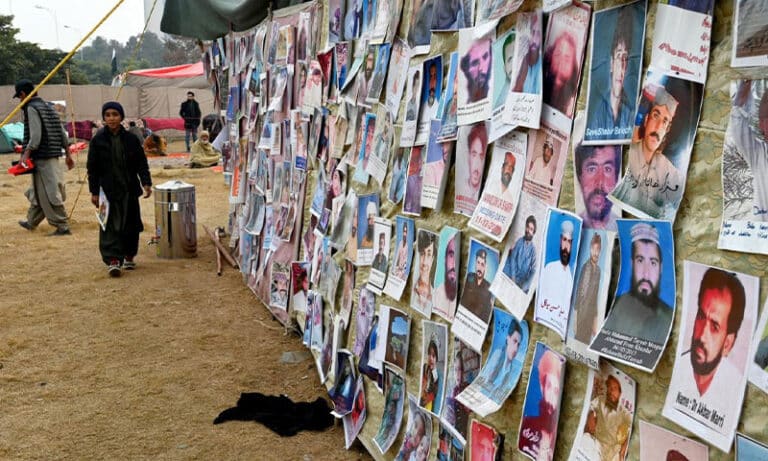
However, a contrasting perspective persists. Families of missing persons and human rights organizations do not fully accept the government’s position. They maintain that thousands of families in Balochistan have been protesting for years for the recovery of their loved ones, and that many cases remain unresolved due to a lack of information. They argue that a few isolated examples cannot be used to generalize about all missing persons.
Analysts say the issue of missing persons in Balochistan remains caught between two competing narratives. On one side, state institutions argue that some of the missing individuals were later found to be linked to militant groups. On the other, affected families and human rights activists continue to demand transparent investigations into thousands of unresolved cases.
Also Read: BLA Violence and Looting Incidents Deepen Anxiety Among Residents
Experts emphasize that a sustainable resolution to this sensitive issue can only be achieved through fact-based investigations, judicial oversight, and the inclusion of all stakeholders’ perspectives.