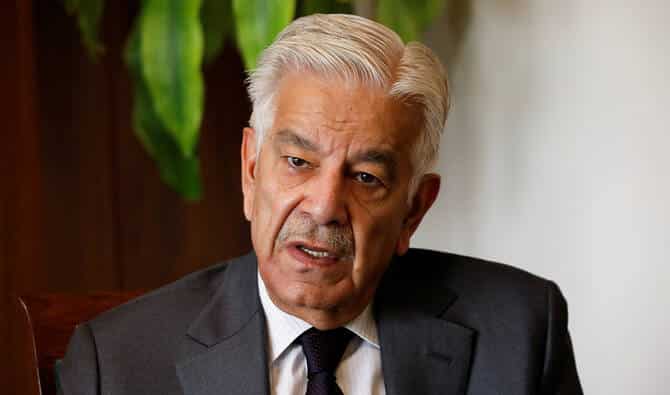
SIALKOT : Defence Minister Khawaja Asif has alleged that the recently formed Joint Action Committee is challenging the historic relationship between Pakistan and Azad Kashmir AJK, while also accusing the group of previously blackmailing the government to collect billions of rupees.
Addressing a political gathering in his native Sialkot on Sunday, the Defence Minister announced his support for the candidate from LA 36 Jammu 3, emphasizing the deep historical bonds between Pakistan and Kashmiri refugees.
Asif recounted the sacrifices made during the 1947 partition, stating that millions of refugees crossed the “blood line” to reach Pakistan, with approximately 250,000 people losing their lives. “These refugees have always been welcomed in Pakistan,” he remarked, highlighting the nation’s enduring hospitality.
The Defence Minister noted that over the past 78 years, differences and contradictions have emerged during elections, but expressed concern that the issue of refugees settled in Pakistan has now been made a central point of contention through the formation of a Joint Action Committee.
In a significant allegation, Khawaja Asif claimed that the same group had previously blackmailed the PPP government and the Pakistani government, collecting Rs 25 billion. He asserted that this action committee is now challenging the relationship between Pakistan and Azad Kashmir, a move he described as deeply concerning.
The Defence Minister also called upon the governments of Azad Kashmir and Pakistan to ensure development works in affected areas, emphasizing their responsibility toward the people.
Addressing public grievances, Asif demanded immediate and effective steps to resolve issues facing the public, particularly stressing the need for basic amenities including proper drainage systems.
The statement comes at a time when political tensions in the region remain high, with various stakeholders voicing concerns over the treatment of Kashmiri refugees and development issues in the affected areas.