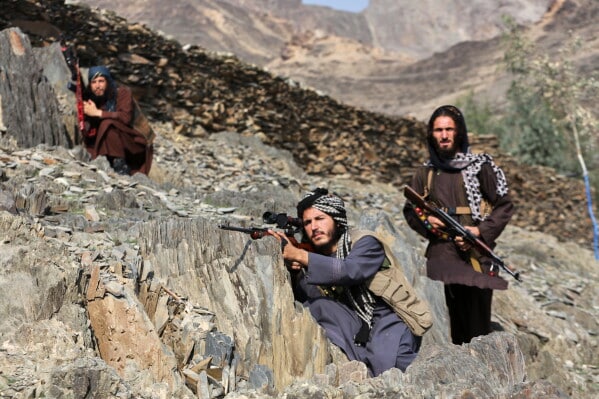
NEW DELHI: India has provided medical treatment to at least one wounded Taliban fighter injured during recent border clashes with Pakistan, underscoring New Delhi’s continued engagement with Taliban-controlled Afghanistan despite international concerns over the group’s status and the sanctions faced by some of its members.
According to Afghanistan International, one wounded Taliban member, accompanied by two attendants, was transferred to New Delhi for medical treatment following injuries sustained during fighting in Afghanistan’s Spin Boldak border region. The individual is currently receiving treatment in the Indian capital and is residing in the Lajpat Nagar area.
The Taliban fighter told the media outlet that his transfer to India was arranged on the direct orders of Taliban Defense Minister Mohammad Yaqoob Mujahid. He further claimed that the Indian Embassy in Kabul facilitated the issuance of his medical visa.
Neither the Indian Embassy in Kabul nor the Taliban’s Ministry of Defense has publicly commented on the report. It remains unclear how many Taliban members have traveled to India for medical treatment under the country’s visa framework.
India suspended regular visa services for Afghan nationals following the Taliban’s return to power in August 2021. However, New Delhi introduced a revised visa regime in 2025, allowing limited categories of visas for Afghans, including medical, humanitarian, business, student, and UN-related travel. Applications are assessed individually, with medical and humanitarian cases receiving particular attention.
The reported treatment of Taliban personnel highlights India’s evolving relationship with Afghanistan’s de facto rulers. While India has not formally recognized the Taliban government, it has steadily expanded diplomatic contacts and humanitarian engagement since the group’s return to power.
The development may attract scrutiny because several senior Taliban figures remain subject to international sanctions and travel restrictions imposed by the United Nations and Western governments. Critics argue that facilitating travel and medical treatment for Taliban members could raise questions about the implementation of international sanctions regimes, although humanitarian and medical exemptions are often permitted under such frameworks.
Tensions between Pakistan and the Taliban administration have intensified in recent years, marked by border clashes, cross-border shelling, airstrikes, and militant violence. Both Pakistani and Taliban forces have suffered casualties, while the United Nations has repeatedly warned that civilians have borne the brunt of the conflict.
India has simultaneously increased its diplomatic and economic footprint in Afghanistan. Since 2021, several Taliban ministers, including Foreign Minister Amir Khan Muttaqi, Industry and Commerce Minister Nooruddin Azizi, and Public Health Minister Noor Jalal Jalali, have visited India. Islamabad has generally viewed these growing contacts with caution, seeing them through the lens of regional geopolitical competition.
The latest case of a wounded Taliban fighter receiving treatment in New Delhi is likely to further highlight India’s pragmatic engagement with the Taliban administration as it seeks to maintain influence in Afghanistan amid shifting regional dynamics.