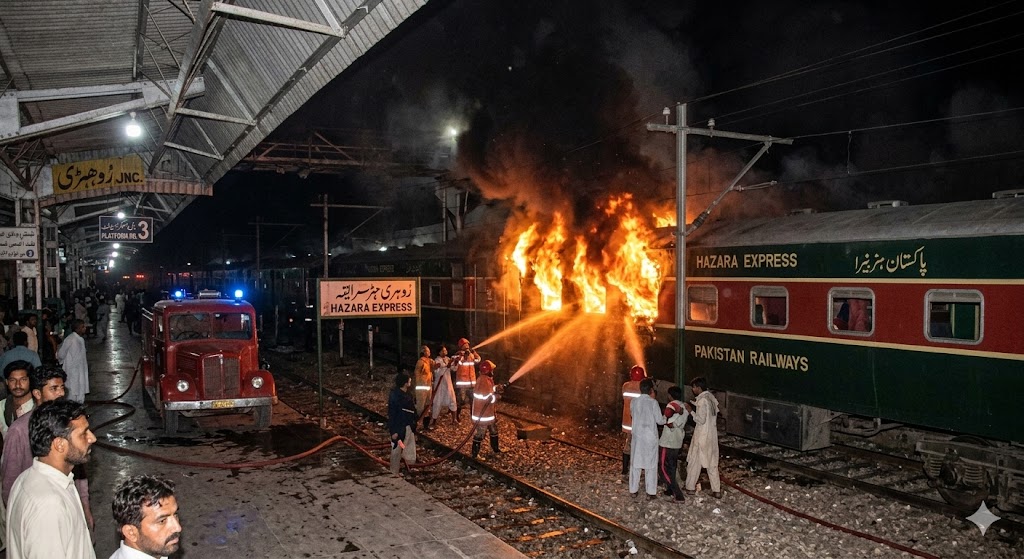
SADIQABAD: A massive fire erupted in a passenger coach of the Hazara Express while it was stationary at the Rohri Railway Station.
According to private television reports, the train was en route from Karachi to Abbottabad when one of its compartments suddenly caught fire.
Railway authorities and rescue teams immediately initiated emergency relief operations, scrambling to safely evacuate all passengers from the affected carriage while firefighters worked to contain the blaze.
The Crisis of Railway Safety and Train Accidents in Pakistan
The fire incident aboard the Hazara Express is another reminder of the deep-seated safety crisis plaguing Pakistan Railways.
Over the decades, the country’s railway network—once a proud symbol of national connectivity—has become synonymous with frequent, fatal accidents.
These disasters range from catastrophic head-on collisions and derailments in remote tracks to devastating onboard fires caused by systemic negligence or short-circuits.
The root causes of Pakistan’s railway vulnerabilities are multifaceted. Chief among them is a severe lack of long-term investment in infrastructure.
Much of the signaling equipment, passenger coaches, and track networks date back to the colonial era, left to decay without proper maintenance or modern upgrades.
Furthermore, train coaches regularly lack basic, functioning emergency equipment, such as fire extinguishers and automated cooling systems, turning minor electrical failures into deadly traps.
Compounding these mechanical failures is the issue of administrative mismanagement and insufficient training for railway staff, which frequently delays critical emergency responses when disasters strike.
Public memory remains scarred by major tragedies, including the 2005 Ghotki rail crash and the horrific 2019 Tezgam train fire, the latter of which claimed over 70 lives after gas cylinders exploded inside passenger compartments. Despite consecutive governments vowing comprehensive structural overhauls and stricter safety enforcement, progress remains sluggish.
The recurring nature of these incidents highlights an urgent need for independent safety audits, the immediate replacement of vulnerable tracks, and a complete modernization of emergency protocols.
Without a fundamental shift from reactive firefighting to proactive, technology-driven maintenance, the safety of millions of low-income citizens who rely on Pakistan Railways will continue to hang in a perilous balance.