ISLAMABAD: Pakistan’s deadline for undocumented Afghan nationals to leave the country expires on July 10, after which authorities will launch the second phase of arrests and deportations, officials said, as the government intensifies a nationwide security crackdown following a recent militant attack in Karachi.
The renewed enforcement drive comes after a June 28 attack on a Rangers headquarters in Karachi. Following the assault, the government decided to adopt a zero-tolerance approach toward security threats. Law enforcement agencies have since expanded intelligence-based operations against suspected militant sleeper cells and hideouts across the city.
Security officials say the campaign targets individuals who threaten national security and that no further extension to the deportation deadline will be granted.
Karachi residents welcome security operations
Residents affected by the recent violence say the crackdown has improved their sense of security.
Kamran Ahmed, 34, who lives in Karachi’s Gulshan-e-Iqbal neighborhood, recalled the panic that followed the June 28 attack.
“I was at a nearby market when explosions and gunfire echoed across the area,” he said. “The operation has reassured residents. People want lasting peace.”
Ahmed said authorities needed to thoroughly verify undocumented residents to improve the city’s security situation.
Shahzaib Khan, a 21-year-old university student who regularly travels through areas with large migrant populations near Sohrab Goth, said security checks had already changed conditions on the ground.
“Biometric verification and search operations have made a visible difference,” he said. “People now feel safer.”
Experts cite long-standing security concerns
Security analyst and retired law enforcement officer Aslam Saleem said Karachi has struggled with illegal settlements and militant sleeper cells for decades.
He said authorities conducted several operations since the 1990s, but political considerations and the expansion of informal settlements allowed the problem to persist.
“In the past, militants often disappeared into these settlements whenever security operations began,” he said. “The current campaign is different because authorities are using modern technology and intelligence-sharing to locate suspects more effectively.”
Social affairs expert Nadia Rehman said many countries strengthened border controls and immigration enforcement after major terrorist attacks.
She cited the United States and Britain as examples of countries that introduced stricter measures to protect national security after significant security incidents.
Also Read: Pakistan Rejects Reports of UAE Deportation Crackdown
She said Pakistan’s current policy reflects a similar objective of protecting its citizens.
Officials rule out deadline extension
Government and security officials say the July 10 deadline will remain unchanged.
A senior law enforcement official, speaking on condition of anonymity, said intelligence-based operations were continuing in Karachi’s sensitive areas.
“The objective is not to target any particular community,” the official said. “The operation aims to eliminate facilitators of militant groups and hostile networks that threaten Pakistan’s security.”
Business leaders and many residents in Karachi have expressed support for the campaign, arguing that restoring law and order is essential for economic stability.
Khyber Pakhtunkhwa accelerates deportation preparations
Authorities in northwestern Khyber Pakhtunkhwa province have also stepped up preparations to implement the federal government’s policy.
A recent meeting of the provincial Home and Tribal Affairs Department reviewed security conditions, undocumented residency, and the repatriation process.
Officials assessed progress on previous directives and instructed authorities to speed up voluntary returns before enforcement begins.
The meeting also decided that police, district administrations, and other law enforcement agencies would adopt a joint strategy for operations beginning on July 10.
Police begin awareness campaign
A senior police officer in Peshawar said preparations had been completed and awareness campaigns were already underway.
“We are informing Afghan nationals about the deadline and encouraging them to return voluntarily,” the officer said.
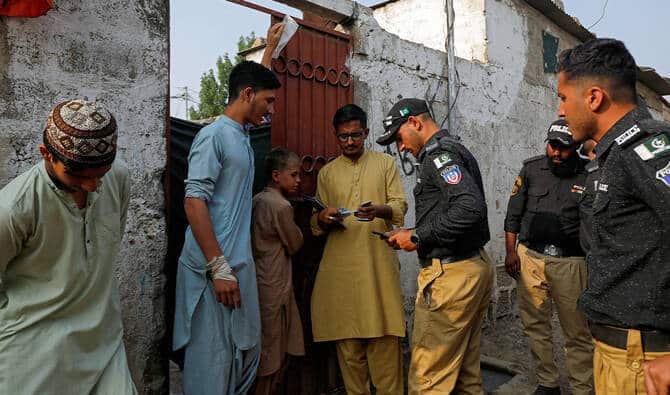
He said police had prepared station-level lists identifying undocumented Afghan nationals living in each jurisdiction.
“We are conducting door-to-door visits and warning residents that arrests will begin after July 10,” he said.
The officer said police had been instructed to avoid unnecessary force and prioritize voluntary returns wherever possible.
He added that returns from Peshawar remained lower than those from several other districts and provinces.
“Action will be taken against any Afghan Citizen Card holder or other foreign national who does not possess valid legal documents to stay in Pakistan,” he said.
Authorities have also prepared transit facilities in Khyber district to process deportees before their return to Afghanistan.
Police, district administrations, and other government agencies will jointly oversee the operations across Peshawar and other districts of Khyber Pakhtunkhwa.
Nearly one million Afghans returned since April
According to official figures, 988,812 Afghan nationals have returned from Pakistan since April 2025.
The total includes 686,772 undocumented Afghans, 71,570 holders of Afghan Citizen Cards, and 230,470 holders of Proof of Registration (PoR) cards.
According to the UN Refugee Agency (UNHCR) and the International Organization for Migration (IOM), more than 2.39 million Afghans returned from Pakistan between September 2023 and May 2026, with most returning voluntarily.
UNHCR says more than 932,000 registered Afghan refugees holding PoR cards remain in Pakistan. The total Afghan population in the country, including both documented and undocumented individuals, is estimated at around 2 million, with the largest concentration living in Khyber Pakhtunkhwa.