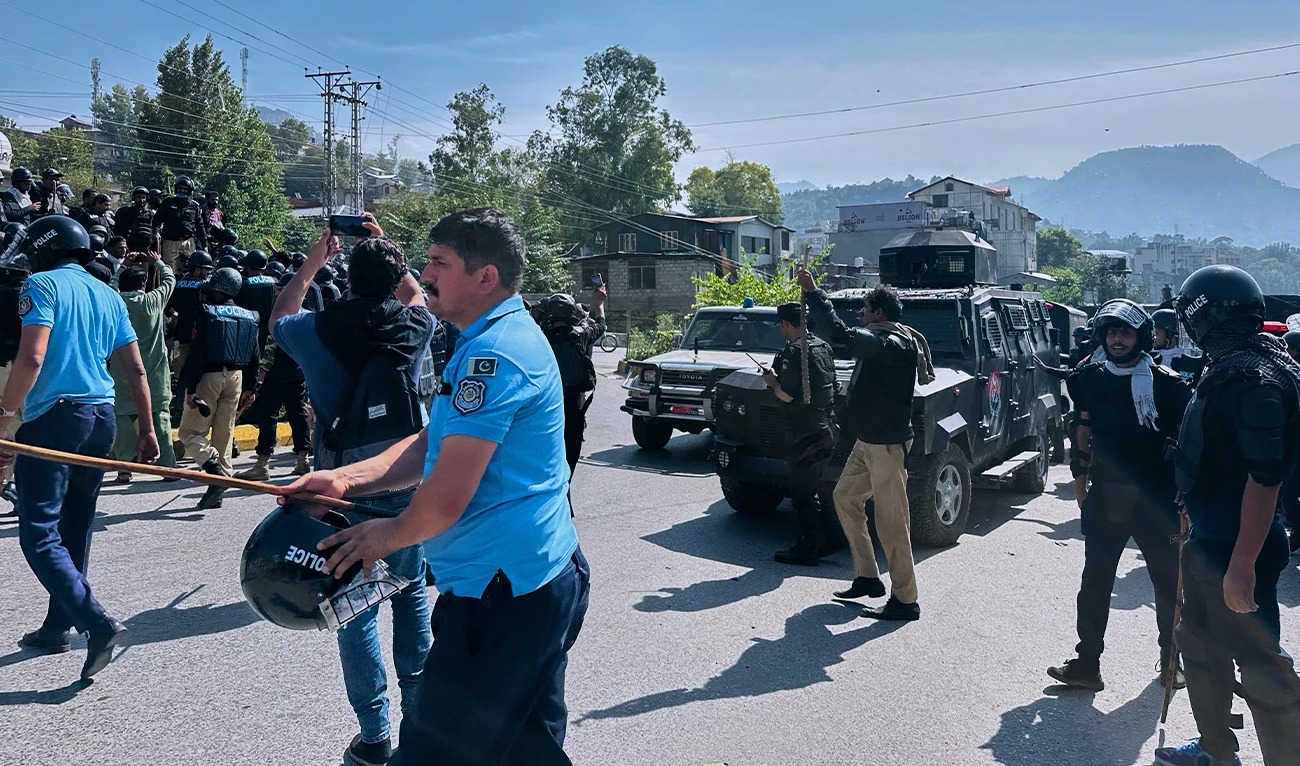
ISLAMABAD: The banned Joint Awami Action Committee (JAAC) armed attack on a police checkpost in Azad Kashmir’s Bagh district martyred a police constable on Saturday.
According to a statement issued by the Deputy Inspector General of Police for the Poonch region, armed attackers opened indiscriminate fire on the Kopra Police checkpost at around 6:35 a.m.
Constable Rahim Gul, a resident of Karak, sustained gunshot wounds and later died, the statement said.
Police said security personnel returned fire and killed one of the attackers. Two hand grenades, a Kalashnikov rifle, ammunition and a dagger were recovered from the slain attacker, while authorities were working to establish his identity.
The police vowed legal action against those challenging the writ of the state and those involved in attacks on law-enforcement personnel.
The incident comes amid heightened tensions in Azad Kashmir following weeks of deadly clashes between security forces and protesters. The unrest has also overlapped with regional elections that began in July.
The JAAC, a grassroots movement that has campaigned over economic grievances, governance and political representation, was banned by the Azad Kashmir government under anti-terrorism legislation in June.
However, the group categorically rejected the police allegations, saying it had no connection to the attack.
“The Jammu Kashmir Joint Awami Action Committee categorically declares that it has no connection whatsoever with any armed attack, firing, or violence,” the group said in a statement, describing the police account as “factually incorrect.”
The JAAC also alleged that the attack could have been carried out by “planted elements” to discredit its movement. It urged authorities to focus instead on implementing what it described as the already acknowledged demands of peaceful and unarmed protesters.
At the heart of the dispute between the JAAC and Azad Kashmir authorities is the allocation of 12 seats in the regional assembly reserved for refugees from Indian-administered Kashmir who live elsewhere in Pakistan.
The seats were created to provide political representation to people displaced from Indian-administered Kashmir who settled in other parts of Pakistan.
The JAAC opposes the arrangement, arguing that it gives disproportionate political influence to people living outside Azad Kashmir, and has demanded that the reserved seats be abolished.
The Azad Kashmir government, meanwhile, has denied allegations by rights groups and the JAAC that security forces killed protesters during the unrest.