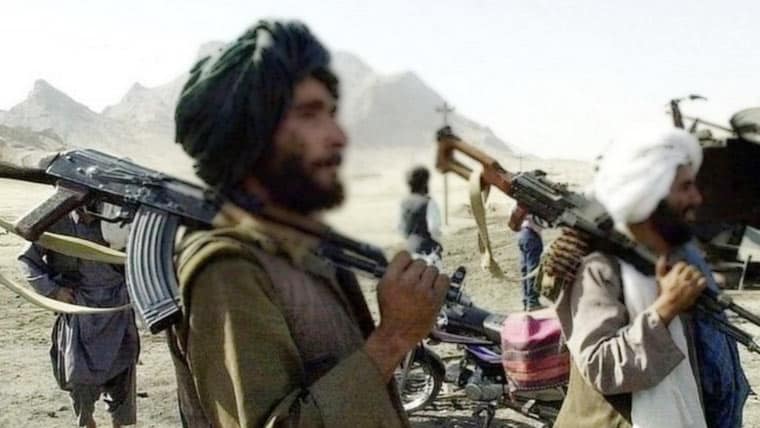
KABUL: An international acknowledgment has emerged regarding the Afghan Taliban regime’s patronage of the terrorist group “Fitna-al-Khawarij” (Tehrik-i-Taliban Pakistan).
Speaking to an Afghan television channel, the UK’s Special Representative for Afghanistan, Richard Lindsay, confirmed that Fitna-al-Khawarij is a terrorist organization receiving active support from within Afghanistan to carry out operations against Pakistan.
Lindsay noted that the group also leverages extensive tribal, cross-border, and familial networks for its support base.
He emphasized that Taliban authorities in Kabul and Kandahar must take decisive action against the outfit, adding that questions regarding the scale of this support should be directed squarely at the Afghan Taliban.
Currently, Fitna-al-Khawarij operates active training camps inside Afghanistan, utilizing advanced weaponry and receiving substantial financial assistance.
Afghanistan has effectively become a safe haven for terrorists fleeing security operations inside Pakistan.
The British envoy further observed that Pakistan’s ongoing military response is a direct consequence of the regional instability caused by these cross-border attacks.
Defence analysts concur that the presence of such terrorist networks in Afghanistan poses a persistent threat to regional security, warning that the continuous supply of finance, training, and arms to these groups ultimately necessitates large-scale counter-terrorism initiatives like Operation Ghazab-fil-Haq.
Context: Cross-Border Militancy from Afghanistan into Pakistan
The issue of cross-border militancy from Afghanistan has remained one of Pakistan’s most critical security challenges for over two decades.
Following the post-9/11 military operations in Afghanistan, various militant factions, most notably the Tehrik-i-Taliban Pakistan (TTP)—officially designated by Pakistan as “Fitna-al-Khawarij”—exploited the porous 2,640-kilometer border to find sanctuary. Whenever pressured by Pakistan’s military offensives in the tribal areas, these groups frequently retreated into the rugged, ungoverned pockets of eastern Afghanistan.
The landscape shifted dramatically after the Afghan Taliban returned to power in Kabul in August 2021.
Despite initial hopes in Islamabad that a friendly administration in Kabul would rein in anti-Pakistan elements, cross-border attacks spiked substantially.
Strikingly, the TTP gained greater operational freedom, accessing high-tech weaponry left behind by departing NATO forces.
The group has used Afghan soil to plan, finance, and execute lethal ambushes against Pakistani security forces and civilian targets.
This persistent threat has severely strained bilateral relations, forcing Pakistan to implement strict border fencing, tighten visa controls, and launch targeted counter-terrorism operations to secure its western frontier against regional instability.