
NEW DELHI: Authorities in Uttar Pradesh demolished a mosque believed to be around a century old at the Saharanpur district magistrate’s office complex on Saturday, after a court upheld an earlier order declaring the structure unauthorised.
Samajwadi Party MP Iqra Hasan said she was stopped from leaving her residence in Kairana and was unable to travel to Saharanpur. She said she had planned to meet government officials and seek time over the demolition.
The action came after a complaint filed by a former Bajrang Dal functionary, who alleged that the mosque occupied government land without legal authorisation.
Bajrang Dal and Vishva Hindu Parishad are Hindu nationalist organisations affiliated with the wider Rashtriya Swayamsevak Sangh network, which is regarded as the ideological parent organisation of India’s ruling Bharatiya Janata Party.
Indian authorities have demolished a mosque in Saharanpur, Uttar Pradesh, following a court ruling. The case was filed by a member of a Hindu nationalist group.
Mosque authorities say the building dates back to 1911. Rights groups are questioning the legality of the decision. pic.twitter.com/yHXkbTFtZg
— Al Jazeera English (@AJEnglish) September 5, 2026
A city magistrate’s court ordered the mosque’s removal on July 17, describing the site as an encroachment and an unauthorised occupation of government property. The court also directed occupants to pay compensation estimated at around 641 million Indian rupees, equivalent to approximately $7.3 million.
The order was subsequently challenged before a district court. However, the challenge was rejected on Friday, leaving the demolition order in force.
Hasan said the mosque had been sealed and that security barricades had been installed around the site following the court ruling.
Speaking to local media, she said members of the community had hoped to meet officials and request additional time so that they could pursue legal remedies, including approaching the High Court.
Hasan condemned the demolition and criticised the authorities for proceeding with the action despite efforts to seek further legal relief. She described the incident as evidence of what she called a serious decline in democratic practices.
Dozens of Muslim Religious Sites Reportedly Demolished
The Saharanpur demolition comes amid reports of several Muslim religious structures being removed in different parts of India.
Media reports said at least 23 mosques, shrines and other Muslim religious sites were demolished across Delhi, Uttar Pradesh, Maharashtra, Gujarat, Rajasthan and Haryana during May and June. In some cases, the structures were reportedly described as historically significant, including one mosque said to be about 1,000 years old.
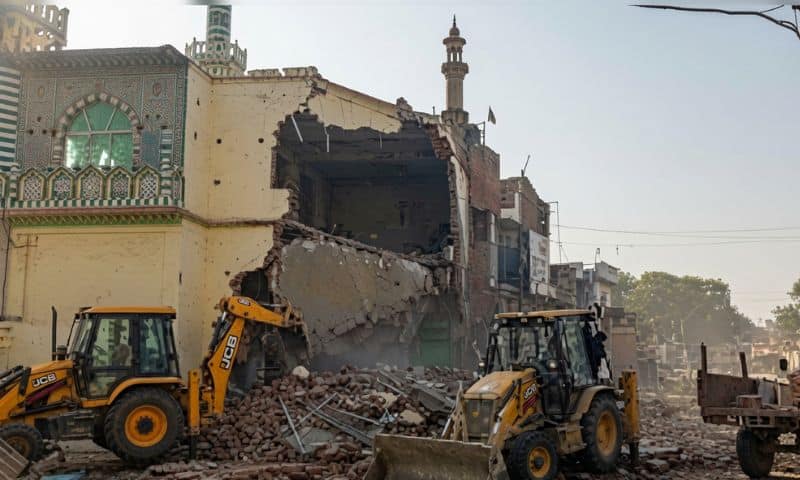
Government authorities have generally cited anti-encroachment campaigns, infrastructure projects and road-widening programmes as the reasons for removing the structures.
Rights Groups Raise Due-Process Concerns
Human rights organisations have raised questions about whether adequate legal safeguards were observed during some of the demolitions.
Rights advocates have alleged that residents and religious communities were not always given sufficient notice or an opportunity to challenge the decisions before demolition work began. They argue that such actions raise broader concerns about due process and the protection of religious sites.
Also Read: India’s UP Govt Continues Anti-Muslim Campaign, Razing Mosques
US-based advocacy group Justice For All has also voiced concern over the reported demolitions, urging authorities to safeguard religious freedom and ensure that laws are applied equally.
The incidents have contributed to wider debate over religious freedom and minority rights in India. Muslim organisations and rights groups have repeatedly expressed concerns that administrative measures, criminal proceedings and actions involving religious properties can disproportionately affect the country’s Muslim population.
Critics argue that the repeated demolition of Muslim religious sites warrants greater scrutiny to ensure that government actions are based on consistent legal standards and that affected communities receive appropriate judicial protection.