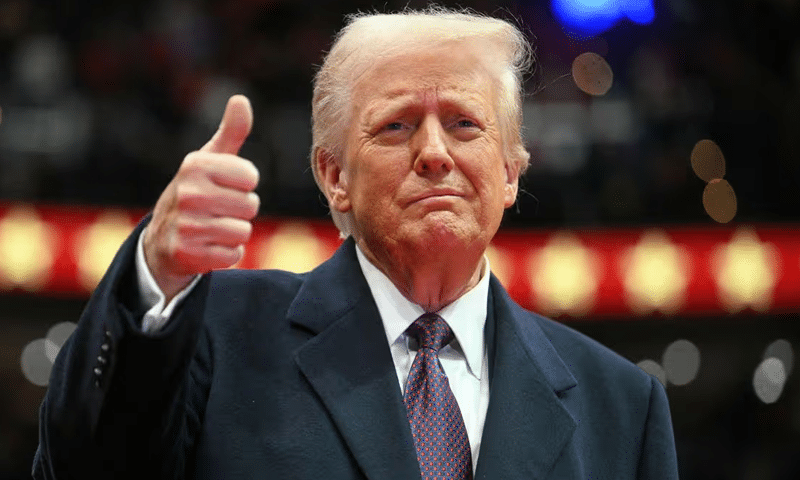
WASHINGTON: US President Donald Trump has welcomed the Makkah Defence Agreement between Pakistan, Saudi Arabia and Turkiye, describing the pact as a “big, bold and very important first step” towards greater regional unity and stronger collective defence.
In a statement posted on his social media platform Truth Social, Trump congratulated the leadership of the three countries and said he was “very pleased” to see the agreement signed.
Trump congratulated the leadership of Saudi Arabia, Türkiye and Pakistan, calling the agreement a “big, bold and very important first step.”
He concluded his post with an enthusiastic: “Wow!”
But what does the Makkah Defence Pact actually contain, and why is it being viewed as a significant development in the region’s security landscape?
What is the Makkah Defence Pact?
The agreement brings Pakistan, Saudi Arabia and Turkiye into a trilateral defence framework aimed at strengthening collective security and defence cooperation.
The central principle reported in connection with the pact is that an armed attack against any one of the three countries would be regarded as an attack against all three. The provision gives the agreement a collective-defence character similar in principle to mutual-defence arrangements used by other military alliances.
The pact also calls for enhanced cooperation in defence and security matters, although the publicly available reporting does not yet provide a complete, detailed text setting out every operational commitment.
Why is the Pakistan Saudi Arabia Turkiye Defence Pact Important?
The Pakistan Saudi Arabia Turkiye defence pact links three countries with significant military and strategic capabilities and could give their existing defence relationships a more coordinated regional dimension.
For Pakistan and Saudi Arabia, the agreement builds on a long-standing military partnership that was formalised through the Strategic Mutual Defence Agreement signed in September 2025. That bilateral pact stipulated that aggression against one country would be treated as aggression against both. Pakistani officials subsequently described it as covering a broad range of cooperation, including defence technology, military training, intelligence sharing and joint exercises.
Turkiye also has extensive defence ties with Pakistan, including cooperation in defence production and naval projects. Pakistan and Turkiye have, for example, worked together on the MILGEM-class corvette programme.
The new trilateral framework therefore brings together existing bilateral relationships under a wider collective-security arrangement.
What does it mean for regional security?
The pact could strengthen coordination among the three countries at a time of heightened security tensions in the Middle East and wider region.
For Saudi Arabia, closer defence cooperation with Pakistan and Türkiye could provide another layer of strategic partnership alongside its existing security relationships. For Pakistan and Turkiye, the arrangement provides an opportunity to deepen their role in regional security cooperation.
The agreement should not, however, automatically be interpreted as creating a NATO-style military alliance with identical institutional structures or an automatic military response in every circumstance. The exact mechanisms for consultation, military assistance and implementation will depend on the pact’s detailed provisions and subsequent arrangements.
The significance of the Makkah agreement therefore lies primarily in its collective-defence principle and the commitment to deepen defence cooperation among Pakistan, Saudi Arabia and Turkiye.
Trump, meanwhile, described the development as evidence that Middle Eastern countries are becoming more united and better able to defend themselves.
Congratulating the leaders of Pakistan, Saudi Arabia and Turkiye, he called the agreement a “big, bold and very important first step” and ended his message with an emphatic: “Wow!”