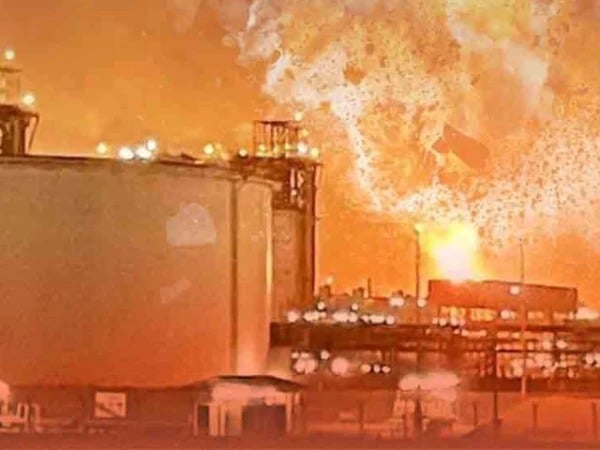
DOHA: A massive explosion triggered a fierce fire at one of the world’s largest liquefied natural gas (LNG) plants, located in Qatar’s Ras Laffan Industrial City.
The incident occurred at the Barzan gas supply facility during restarting operations following a temporary shutdown.
Qatari authorities stated that a technical fault caused the blast, which led to a rapidly spreading fire.
Emergency services and civil defense teams responded immediately, containing the blaze and transporting the casualties to hospitals.
The incident resulted in 13 fatalities and left 66 people injured. The deceased include Pakistani and Indian nationals, while the injured span multiple nationalities, including citizens from Qatar, Tanzania, India, Pakistan, Guinea, Nepal, Bangladesh, Kenya, and Nigeria.
The LNG operating company has initiated a technical investigation to determine the exact cause of the incident, assuring that export infrastructure and domestic gas supplies remain unaffected.
QatarEnergy confirmed that a comprehensive report detailing the root cause and the verified identities of the victims will be released upon completion of the probe.
To stabilize global markets, QatarEnergy emphasized that LNG exports, gas processing operations, and activities at the Ras Laffan port continue to function normally.
Ras Laffan Industrial City stands as a critical global energy hub, managing massive production and export operations.
Given Qatar’s status as a top global LNG exporter, this severe disruption initially triggered concerns across international energy markets.
The Gulf region, housing some of the world’s largest hydrocarbon reserves, has a history of devastating industrial accidents in its oil and gas sectors.
Due to the highly volatile nature of high-pressure gas processing and refining, technical failures often lead to catastrophic outcomes.
Over the decades, major state-owned facilities in Kuwait, Saudi Arabia, and the United Arab Emirates have experienced fatal explosions caused by gas leaks, corroded pipelines, or operational errors during maintenance shutdowns.
Notably, a major explosion at Kuwait’s Mina Al-Ahmadi refinery in 2000 caused extensive fatalities and infrastructure damage, highlighting the inherent risks of downstream processing.
Similarly, Saudi Aramco facilities have faced sporadic fires and extraction accidents that resulted in worker casualties, emphasizing how even minor mechanical anomalies can rapidly escalate into lethal disasters under extreme pressures.
Because these massive complexes rely heavily on a diverse multinational workforce, these tragic events frequently result in casualties among foreign technicians and laborers.
Consequently, such fatal incidents invariably prompt regional energy conglomerates to implement stringent safety overhauls, balance production targets with risk mitigation, and invest heavily in automated automated shutdown systems to safeguard human life and global supply stability.