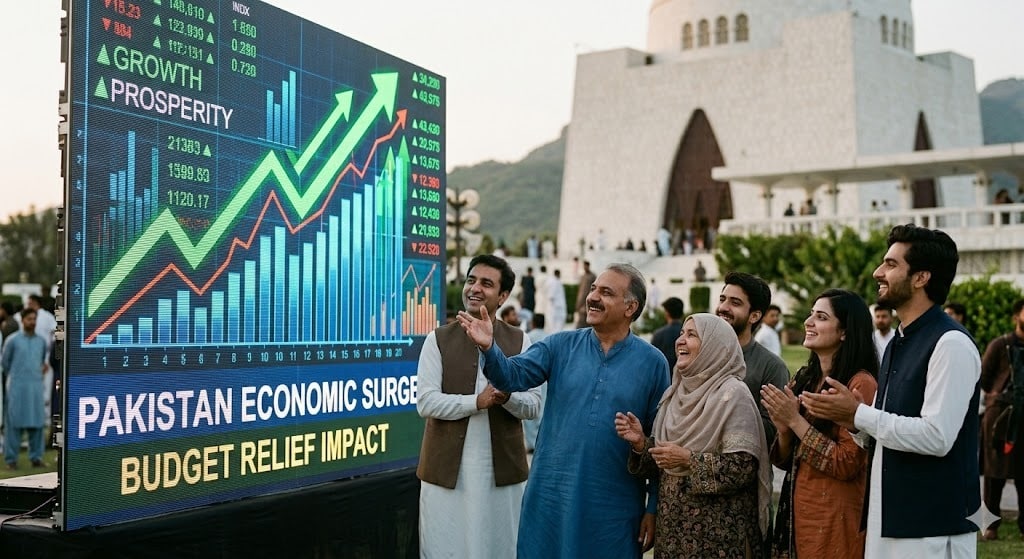
ISLAMABAD: In a major stride toward economic stabilization and public welfare, the federal government, under the leadership of Prime Minister Muhammad Shehbaz Sharif, has unveiled a comprehensive national budget designed to foster sustainable growth, restore market confidence, and alleviate the financial burden on citizens.
Amid global economic pressures where many nations are rolling back subsidies and imposing stringent fiscal measures, Pakistan’s federal administration, in close coordination with provincial governments, has prioritized public relief and industrial stimulation.
Relief for the Salaried Class across the Board
The cornerstone of this year’s budget is an unprecedented tax relief package tailored specifically for the formal, salaried class who serve as the compliant backbone of the national economy.
To ensure significant financial breathing room, the government has completely abolished the previously applicable 10 percent surcharge across all salaried brackets.
Furthermore, the financial administration restructured the income tax framework by introducing two new transitional slabs between PKR 4.1 million and PKR 7.0 million to eliminate steep, sudden taxation leaps.
Under the newly approved schedule, salaried individuals earning between PKR 2.2 million and PKR 3.2 million annually will see their tax rate slashed from 23 percent to 20 percent, yielding an average annual saving of PKR 65,000.
For those in the PKR 3.2 million to PKR 4.1 million bracket, the rate drops from 30 percent to 25 percent, providing a relief of approximately PKR 102,500.
Middle and upper-middle-class professionals earning between PKR 4.1 million and PKR 5.6 million will benefit from a rate reduction to 29 percent (down from 35 percent), saving roughly PKR 170,000 annually.
Meanwhile, the slab spanning PKR 5.6 million to PKR 7.0 million has been reduced from 35 percent to 32 percent, translating to a saving of PKR 236,000.
High earners making above PKR 7.0 million will see their baseline rates maintained, but the removal of the 10 percent surcharge will grant them an annual relief of about PKR 257,000.
Concurrently, public sector employees and pensioners received a vital cushion against inflation through a approved 7 percent increase in salaries and pensions.
Structural Stimulus for Exports, Shipping, and the IT Sectors
To catalyze industrial productivity and earn foreign exchange, the budget extends aggressive fiscal incentives to the export economy.
The combined advance and minimum tax rate for exporters has been curtailed from 2 percent to 1.25 percent.
Additionally, the government has completely abolished the super tax for exporters generating up to PKR 500 million in revenue, while reducing it from 10 percent to 8 percent for large-scale exporters exceeding that threshold.
The maritime and digital sectors also received sweeping exemptions to enhance regional competitiveness.
The 18 percent sales tax on the shipping industry has been completely zero-rated to lower maritime logistics costs and boost port activities.
For the technology sector, the government opted for policy continuity by maintaining the concessionary 0.25 percent income tax rate for IT exports and freelancers, providing long-term predictability to the digital economy.
Mirroring this digital push, the withholding tax on online and international debit or credit card payments has been aggressively lowered from 5 percent to a minimal 0.5 percent to encourage a cashless economy.
In the energy sector, brownfield oil refineries have been granted a full waiver on the 18 percent sales tax for upgrade-related imports to boost domestic refining capacities.
Relief for Housing, Property Development, and Public Health
The real estate and construction sectors received a major regulatory overhaul to stimulate investment.
For property sales, the transaction tax on properties valued up to PKR 50 million was dropped from 4.5 percent to 2.75 percent, and for properties exceeding PKR 50 million, the rate fell from 5 percent to 2.75 percent.
On the purchasing side, the tax across all major real estate tiers—ranging below PKR 50 million, between PKR 50 million and PKR 100 million, and above PKR 100 million—has been uniformly standardized and reduced to a flat 1.25 percent, down from previous highs of up to 2 percent.
Catering to a long-standing demand of non-resident citizens, the government has entirely eliminated the 1 percent Capital Value Tax (CVT) on properties held by overseas Pakistanis.
Finally, in a significant move toward prioritizing public health and gender-focused social equity, the federal government has completely removed the 18 percent sales tax on essential hygiene and healthcare products, including tampons, sanitary pads, condoms, and other contraceptive medications.
Officials concluded that this holistic budget successfully balances fiscal discipline with targeted relief, laying down a stable foundation for a self-reliant and prosperous Pakistan.