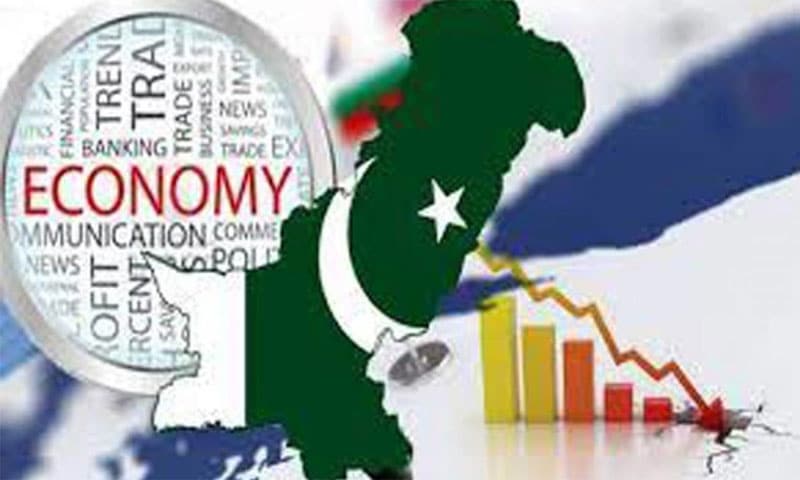
ISLAMABAD: Pakistan’s economy grew by 3.7 percent during the 2025-26 fiscal year, missing the government’s official target as weak industrial and construction activity slowed overall economic momentum, according to media reports and provisional government estimates.
The slowdown also contributed to rising unemployment during the year.
According to media reports, the services sector remained the main driver of growth, while the industrial sector expanded by 3.5 percent and the agriculture sector by 2.9 percent.
Pakistan’s per capita income increased to $1,901 during the fiscal year, supported by higher remittances, improved economic activity and a relatively stable exchange rate.
The overall size of Pakistan’s economy reached $452.1 billion, making the country the world’s 42nd largest economy.
The provisional growth estimates were approved during the 117th meeting of the National Accounts Committee chaired by Planning Secretary Owais Manzoor Sumra.
The Ministry of Planning said the government failed to achieve its 4.2 percent growth target, with the economy expanding at 3.7 percent instead.
The figure also remained below the State Bank of Pakistan estimate of up to 4.8 percent, though it stayed close to forecasts issued by the International Monetary Fund and the Asian Development Bank.
Pakistan has pursued economic stabilization policies over the past four years under IMF-backed reforms. Economists say these measures affected economic output and contributed to rising poverty, unemployment and income inequality.
The government has pledged to continue the stabilization program in the next fiscal year and has committed to achieving a primary budget surplus of Rs2.8 trillion under its agreement with the IMF.
According to the Ministry of Planning, the country’s economy reached Rs126.9 trillion, equivalent to $452.1 billion.
Based on the 2023 census, per capita income stood at Rs533,629, up by Rs44,511 compared to the previous year.
Agriculture Sector
The agriculture sector recorded 2.9 percent growth, improving from 1.53 percent last year. Major crops posted overall growth of 0.7 percent.
Wheat production rose to 29.6 million tons from 28.4 million tons a year earlier. Rice output reached 10 million tons, while sugarcane production increased by 6.2 percent to 89.5 million tons.
Cotton production, however, declined by 0.5 percent to 7.1 million bales. Corn production also fell by 2.7 percent to 8.8 million tons.
Industrial Sector
The industrial sector posted provisional growth of 3.51 percent in fiscal year 2025-26, significantly lower than the previous year.
Economists attributed the slowdown to high taxes, elevated energy prices, expensive borrowing costs and uncertainty in economic policies.
Large-scale manufacturing expanded by 6.11 percent, driven by food products, tobacco, petroleum products, rubber, electrical equipment, automobiles, transport equipment, furniture and football manufacturing.
However, electricity, gas and water supply services contracted by 10.63 percent, while slower construction growth also limited industrial expansion.
The construction sector grew by 5.7 percent compared to 8.8 percent last year. Government subsidies declined by 25 percent to Rs893 billion from Rs1.2 trillion.
Services Sector
The services sector expanded by 4.1 percent during the fiscal year. Wholesale and retail trade, transport, storage, information and communication, public administration, social security and education sectors contributed positively to growth.