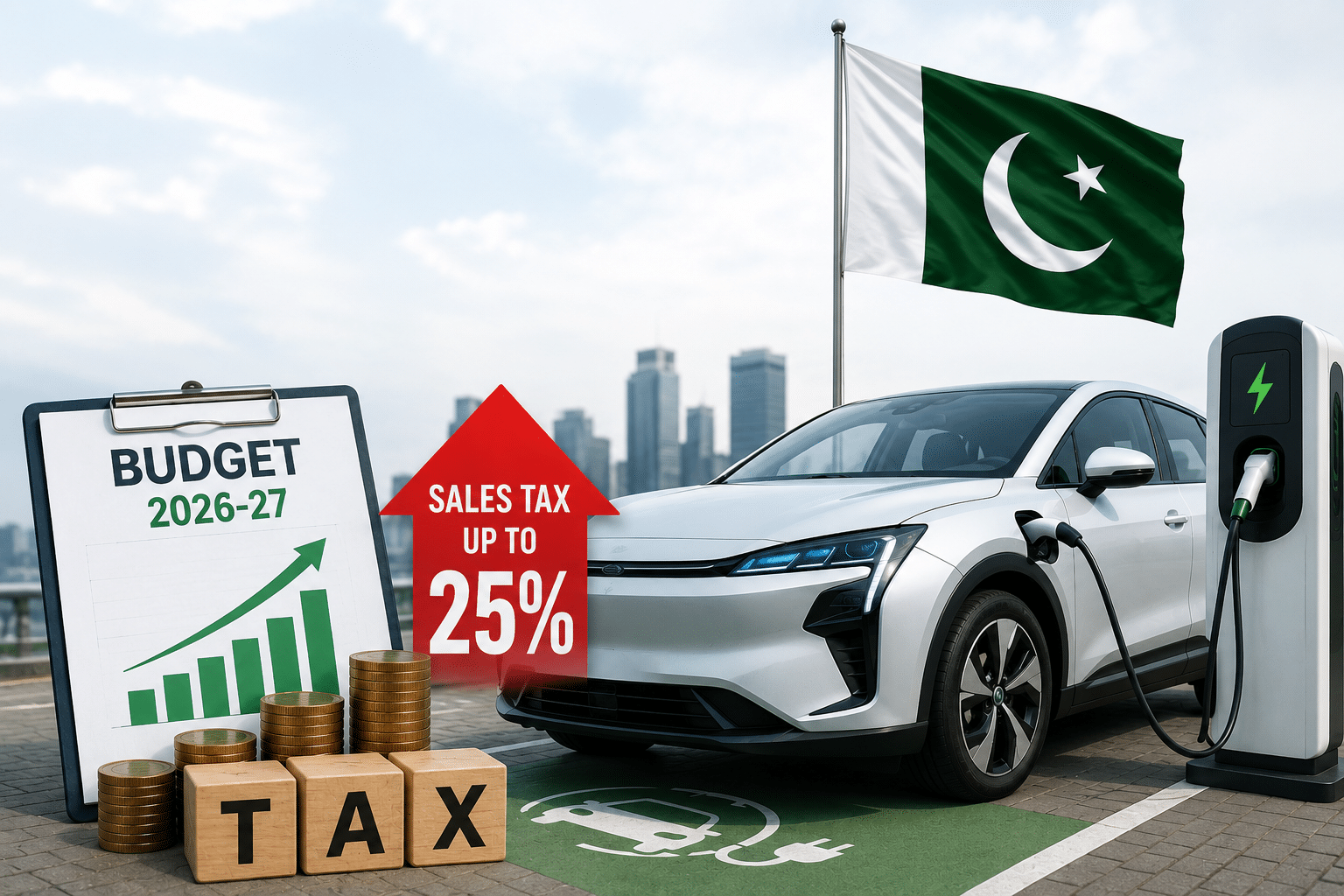
ISLAMABAD: Pakistan’s federal government is likely to raise sales tax on imported electric vehicles (EVs) to as high as 25% in the upcoming budget for fiscal year 2026–27, official sources said.
According to sources, the government is considering a significant revision in tax policy as part of the new federal budget. Under the proposal, imported electric vehicles could face a sales tax increase up to 25%, while existing tax rates on hybrid vehicles are expected to remain unchanged.
Officials said several tax incentives and exemptions granted to the EV sector are set to expire on June 30, 2026. These include sales tax exemptions on the import of complete knock-down (CKD) kits used by local manufacturers.
Under the current policy, reduced tax rates apply to small electric vehicles and SUVs with battery capacity of up to 50 kWh. Light commercial electric vehicles with battery capacity up to 150 kWh also enjoy similar concessions.
Locally assembled four-wheeler electric vehicles currently attract only 1% sales tax until June 30, 2026.
Hybrid electric vehicles produced locally are also taxed at concessional rates ranging between 8.5% and 12.75%. The government is considering retaining these rates in the next fiscal year.
Officials said the broader policy review aims to align incentives with industrial growth, export promotion, and environmental sustainability goals. The government also plans to encourage local EV manufacturing while maintaining investor confidence in the auto sector.
In addition, authorities are considering extending customs duty exemptions on imported EV parts and components to support green mobility and local production capacity.
Pakistan approved its Electric Vehicle Policy in June 2020, granting a five-year customs duty concession on specific EV parts, including components for electric two-, three-, and heavy commercial vehicles.
The incentives were later extended in December 2021 to include light commercial vehicles and vans.
Under the Customs (Amendment) Bill 2026, customs duty exemptions on fully built electric vehicles (CBUs) will also remain in place until June 30, 2026.
Also Read: President Zardari invites Chinese firm to invest in electric vehicles in Pakistan
The scheme remains limited. It allows imports for up to 10 vehicles of a single variant for local assembly or manufacturing. For two- and three-wheelers, the cap stands at 200 units.
The facility applies only to models approved and certified by the Engineering Development Board under the 2020 EV policy.