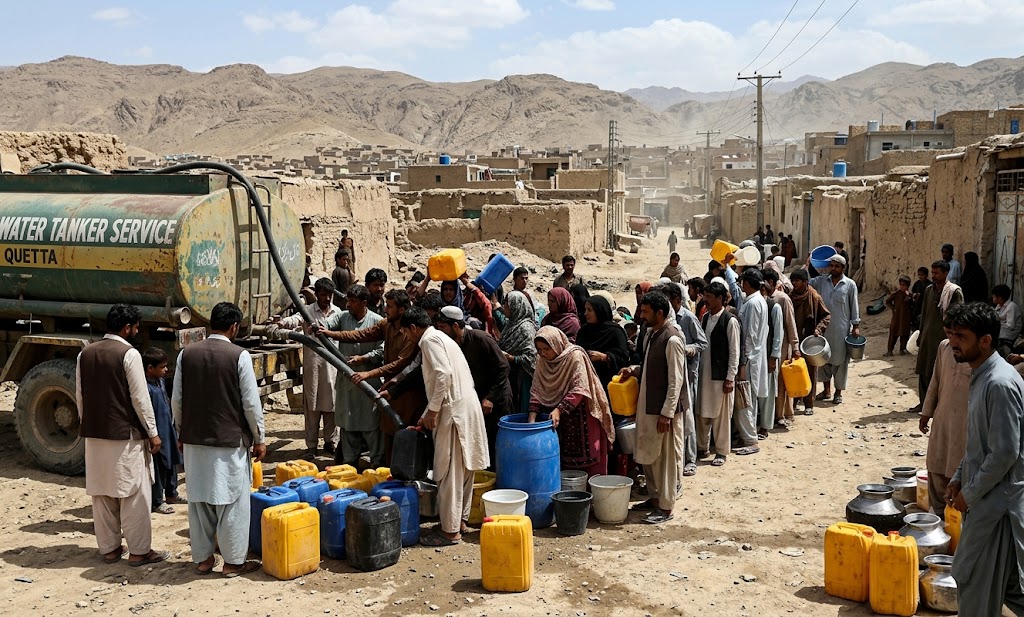
QUETTA: Quetta, the capital of Pakistan’s southwestern Balochistan province, is facing one of the worst water crises in its history as groundwater levels continue to fall and public water supplies shrink, forcing thousands of families to rely on costly private water tankers.
Residents say water shortages have become a daily struggle across much of the city. Many neighborhoods receive piped water only twice a week, while others go for several weeks without any supply.
The crisis has affected several residential areas, including Sariab Road, Samungli Road, Jinnah Town, Brewery Road, Qambrani Road, Sarki Road, Rehmat Colony, Bank Colony, Satellite Town and Sabzal Road.
Women, children and elderly residents often travel long distances to fetch water. Low-income families say they cannot afford the rising cost of private supplies.
Mohammad Naeem, a resident of Sariab Road, said the Water and Sanitation Agency (WASA) supplies water only two or three times a week, and even then for a limited period.
“We pay our monthly water bills regularly, but we still have to buy water from private tankers,” he said.
Another resident, Mohammad Nadeem, said a small water tanker now costs around 2,000 Pakistani rupees ($7), while a large tanker sells for between 2,500 and 3,000 rupees ($9-$11).
Residents accuse a “water tanker mafia” of exploiting the shortage by charging arbitrary prices. They also question why water appears readily available for private tankers while public supplies remain scarce.
According to WASA, Quetta requires about 50 million gallons of water each day but can currently supply only 30 million gallons. The city therefore faces a daily shortfall of around 20 million gallons.
Officials said WASA operates 417 tube wells, but nearly 50 remain out of service because of technical faults. The shutdowns have further reduced water supplies.
Authorities attributed the crisis to rapidly declining groundwater levels, prolonged drought, unreliable electricity for pumping stations and the city’s growing population. They said efforts are underway to repair damaged tube wells and improve the distribution system.
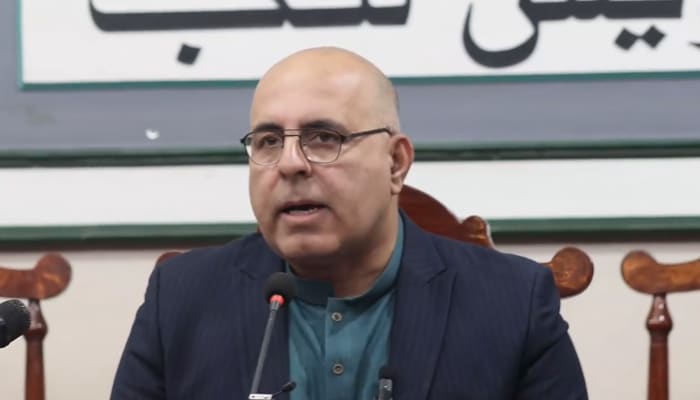
Professor Dr. Din Mohammad Kakar, a leading geologist at the University of Balochistan, warned that Quetta’s water crisis has evolved from an environmental challenge into a threat to the city’s survival.
He said Quetta is extracting large volumes of fossil water—ancient groundwater that accumulated over thousands of years but is being depleted within decades.
According to Kakar, illegal tube wells, unchecked urban expansion, declining rainfall, the absence of new water reservoirs and the lack of an effective groundwater recharge system are accelerating the decline in water levels.
His research has also found signs of land subsidence and ground fissures in parts of the Quetta Valley because of excessive groundwater extraction.
“If current trends continue, Quetta could face a full-scale water emergency within the next few years,” Kakar warned.