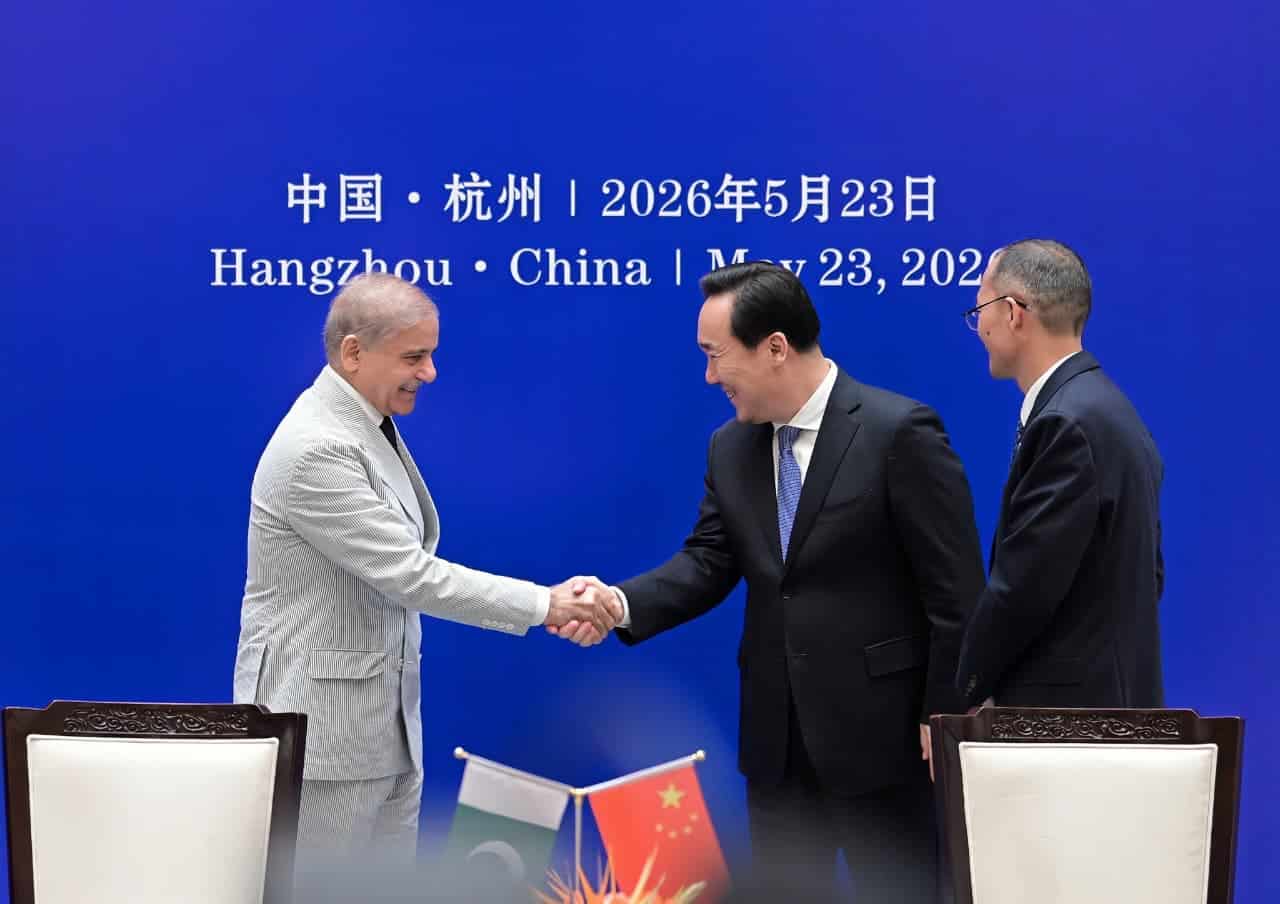

HANGZOU: Prime Minister Shehbaz Sharif and Chinese officials signed two important Memorandums of Understanding (MoUs) during the premier’s visit to China, aimed at strengthening bilateral cooperation in multiple sectors including trade, technology, education and investment.
In this regard, Prime Minister Shehbaz Sharif met with Wang Hao, Secretary of the Zhejiang Provincial Committee of the Communist Party of China.
The Chinese leader warmly welcomed the Pakistani delegation and confirmed Beijing’s commitment to further increasing ties with Pakistan.
The prime minister praised Zhejiang province for its modern development planning and environmentally sustainable economic policies. He also paid tribute to the leadership of Chinese President Xi Jinping, appreciating China’s vision of green and inclusive development.
Meanwhile, the first memorandum signed during the visit focused on establishing “Sister Province” relations between Zhejiang province and Punjab.
The agreement is expected to promote cooperation in trade, investment, agriculture, education, tourism and cultural exchanges between the two regions.
So far, an agreement was signed between Hangzhou Normal University and the Pakistani Embassy in Beijing for the establishment of a China-Pakistan Joint Technology Research Center.
The initiative aims to strengthen academic cooperation, scientific research and technology transfer between institutions of both countries.
In this sense, Prime Minister Shehbaz Sharif said the research center would help deepen institutional linkages and create new opportunities for innovation and educational collaboration.
He noted that Pakistan and China are celebrating the 75th anniversary of diplomatic relations and are entering a new era of development-oriented partnership and people-to-people cooperation.
However, the prime minister further stated that Pakistan is keen to expand cooperation with Zhejiang province in key sectors such as the digital economy, e-commerce, information technology, telecommunications, agriculture, renewable energy and modern industrial development.