NEW YORK: Pakistan has urged the UN Security Council to strengthen international counter-terrorism mechanisms and address gaps in sanctions regimes, warning that terrorist organisations are rapidly adapting their methods of propaganda, recruitment, financing and operations.
Pakistan’s call came during a Security Council discussion marking 25 years since the Sept 11 attacks, as a new United Nations assessment mentioned the changing nature of terrorist threats and the growing use of technology by extremist groups.
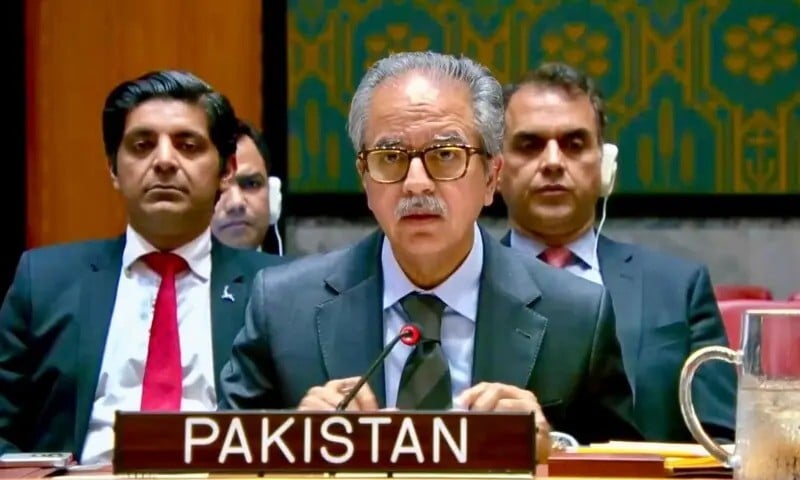
Pakistan’s Permanent Representative to the UN, Asim Iftikhar Ahmad, said the terrorist threat had “evolved and mutated” since the attacks and required stronger international cooperation.
The report by the Security Council’s Counter-Terrorism Committee Executive Directorate said terrorist propaganda had developed beyond simple messaging and had become an important part of the operational structure of extremist organisations.
In this regard, the terrorist groups are using propaganda to recruit fighters, raise funds, support operations, influence public perceptions and, in some cases, facilitate territorial control.
The report specifically cited the proscribed Tehreek-i-Taliban Pakistan (TTP), along with JNIM, Al-Shabaab and ISIL-K, as examples of groups adapting their strategies to changing technological and social environments.
It warned of an “acceleration gap” between the speed at which terrorist organisations adopt new tactics and the ability of governments to update laws and policies.
The UN assessment identified artificial intelligence, gaming platforms, alternative online spaces and other digital technologies as emerging tools being exploited by terrorist organisations.
Pakistan also mentioned the use of drones, the dark web, virtual assets and cryptocurrencies for propaganda, networking, attack planning and terrorist financing.
Pakistan Raises Concern Over Threats From Afghanistan
Ahmad expressed particular concern over terrorism emanating from Afghanistan, saying more than 4,700 Pakistanis had been killed in terrorist attacks over the past three years.
He called for effective international action against groups including the TTP, Balochistan Liberation Army (BLA), East Turkestan Islamic Movement (ETIM) and the so-called Islamic State.
Pakistan also stressed its long-standing role in the international campaign against terrorism, saying more than 90,000 Pakistanis, including civilians and security and law-enforcement personnel, had been killed in terrorist violence since the beginning of the century.
The Security Council observed a minute of silence for the victims of the Sept 11 attacks. US representative Michael Waltz recalled the 2,977 people killed in the attacks and called for stronger efforts to disrupt terrorist financing.
However, he stressed that counter-terrorism measures must remain consistent with international law and human-rights obligations.
ALSO READ: Pakistan condemns Iran attacks at UN Security Council
France’s UN ambassador Jérôme Bonnafont similarly warned that terrorist groups were exploiting technological advances for propaganda, recruitment and financing.
He called on the Security Council to strengthen its leadership and develop effective measures against the misuse of emerging technologies by terrorist organisations.
Meanwhile, more than 30 independent UN human-rights experts warned that the 25-year international campaign against terrorism had also placed significant pressure on human rights and fundamental freedoms, underscoring the need for a counter-terrorism response that protects both global security and international law.