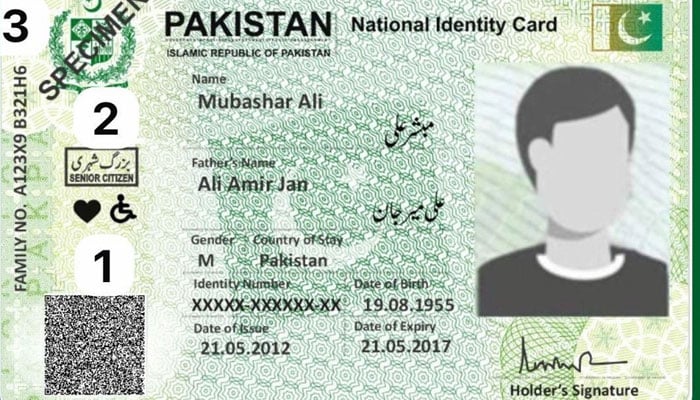
ISLAMABAD: The Federal Government has formally upgraded the country’s National Identity Card (NIC) and Pakistan Origin Card (POC) frameworks under its vision of “One Nation, One Identity.”
The reforms, issued through S.R.O. 330(I)/2026 and S.R.O. 331(I)/2026 and published in the Gazette on February 24, 2026, introduce sweeping technological and administrative changes designed to modernise identity verification and strengthen digital security nationwide.
In this regard, the QR code is defined as a secure, machine-readable, two-dimensional barcode capable of storing encoded identity information for instant verification.
So far, the updated framework empowers the National Database and Registration Authority (NADRA) to incorporate “QR code or any other technological feature,” ensuring flexibility for future innovation without requiring frequent legislative amendments. Officials describe this clause as a forward-looking step toward sustaining a dynamic and adaptive digital identity ecosystem.
The parallel existence of chip-enabled and non-chip cards will be streamlined into a single QR-based architecture. This, officials indicate, aligns the national ID system with broader digital governance platforms, including integration with the National Data Exchange Layer for seamless service delivery.
The government has also tightened fraud prevention measures. The suspension of an identity card will automatically block all associated verification and authentication services, effectively preventing misuse across institutional and digital channels.
The Biometric safeguards have been reinforced, with fingerprints and iris scans now formally recognised as authentication modalities, indicating a transition toward multi-modal biometric identification.
The citizens aged 60 and above both resident and overseas will receive lifetime-validity identity cards bearing a distinct senior citizen logo, eliminating the need for repeated renewals.