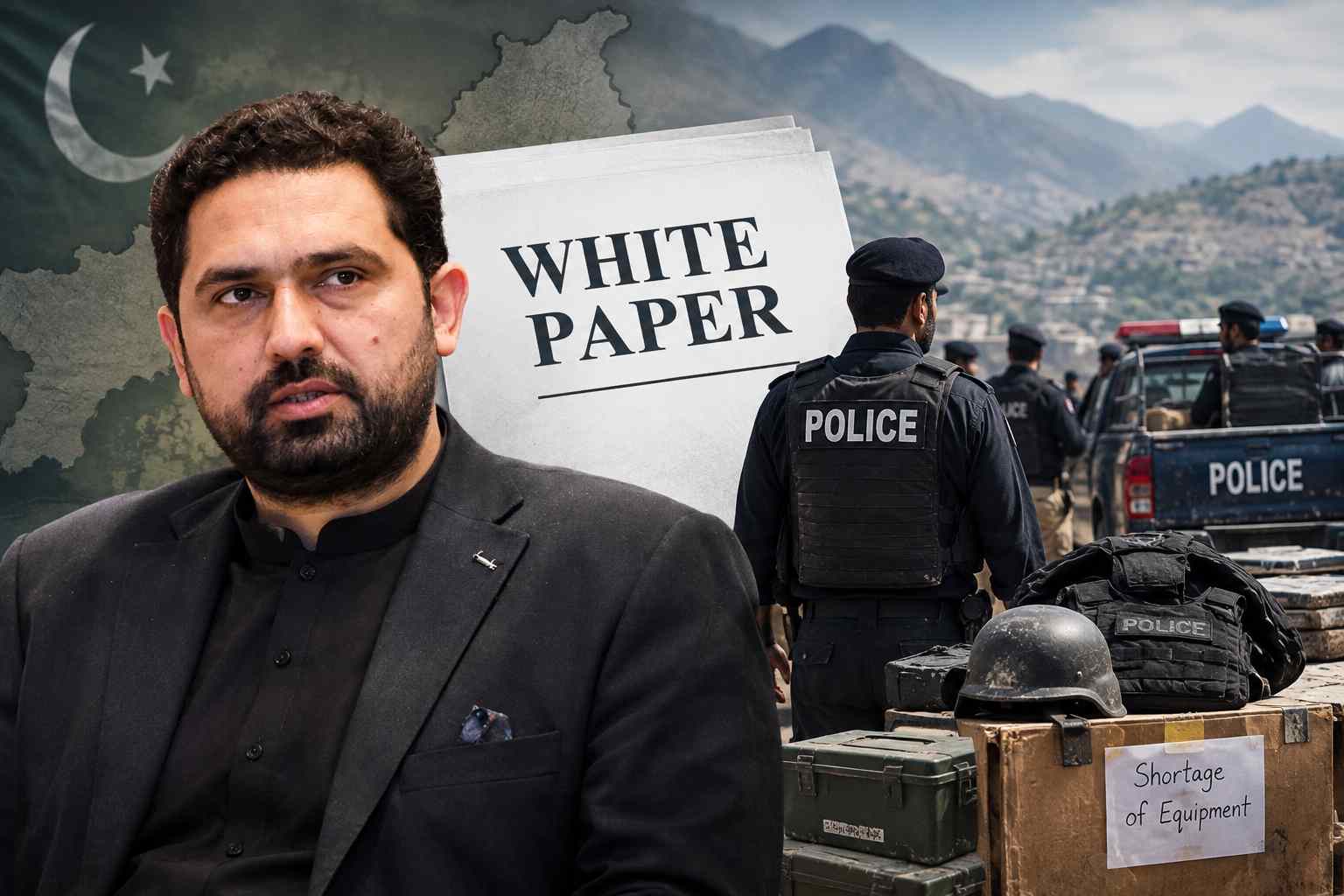
PESHAWAR: Rising militant attacks, mounting police casualties and persistent shortages in counterterrorism resources have exposed serious gaps in Khyber Pakhtunkhwa’s security preparedness, with a new white paper questioning the PTI-led provincial government’s governance and priorities.
The document, which reviews security, governance, drug trafficking and smuggling in the province, questions whether the government’s priorities and institutional response are keeping pace with the deteriorating security situation.
The figures and assessments contained in the white paper represent its authors’ analysis and have not been independently verified.
According to the document, 122 police personnel were killed during the first six months of 2026, compared with 63 in the same period last year — an increase of 93.7%. The number of injured police personnel rose from 84 to 175, an increase of 108.3%.
The white paper also recorded 680 terrorist attacks between January and September 2026, compared with 508 during the corresponding period of 2025, marking a 33.9% increase.
The authors argue that the figures raise questions over the effectiveness of the province’s security strategy as militants continue to operate across several districts.
The security concerns extend to the province’s specialised counterterrorism infrastructure. The document highlights the September attack on the Counter-Terrorism Department and Special Branch offices in Kohat, saying the incident raised questions about the protection of facilities tasked with combating militancy.
The white paper also examined funding for the CTD. The provincial government approved Rs7.77 billion for CTD equipment, of which Rs7.05 billion had reportedly been released by June, leaving around Rs720 million unreleased.
The authors questioned how much of the released money had actually translated into equipment reaching frontline units and being put into operational use.
Manpower shortages remain another major concern. A December 2025 report cited by the document showed 3,113 personnel serving against 3,844 sanctioned CTD positions, leaving about 19% of posts vacant.
By June 2026, recruitment against 638 vacant field-operator positions had also not been completed, according to the white paper.
The document’s comparison of CTD resources across provinces showed KP with only 17 bulletproof vehicles, compared with 76 in Punjab and 42 in Balochistan.
It also cited figures showing that the KP CTD had only nine M4 rifles against a stated requirement of 200, while 11 night-vision devices were available against a requirement of 35.
The shortage of equipment drew further attention in July after an injured police officer reportedly appealed for better weapons, prompting questions over whether frontline personnel were receiving adequate equipment in time.
The white paper also questioned the implementation of decisions taken by the provincial Apex Committee, saying the chief minister chaired the forum’s first meeting 112 days after assuming office.
It said terrorist attacks continued in Bannu, Tank, Hangu and Kohat despite commitments made through the forum and called for greater transparency over the implementation and measurable results of its decisions.
Beyond terrorism, the document points to continuing challenges involving drugs and smuggling.
Police operations during the first quarter reportedly resulted in the seizure of 5,695 kilograms of hashish, 847kg of ice, 210kg of heroin and 275kg of opium. In September, authorities in Peshawar reportedly seized a 960kg consignment of drugs and raided two suspected synthetic-drug production facilities.
The white paper said the scale of seizures warranted greater focus on the networks behind drug trafficking, including suppliers, financiers and distribution channels.
Efforts to eradicate drug cultivation also came under scrutiny. Budget records cited by the document set an annual target of 250 kanals for crop eradication. By April, action had been taken over 130 kanals, while the document said authorities had achieved 52% of the annual target during the first 10 months of the financial year.
Smuggling was another area highlighted by the report. A customs report from July reportedly showed seizures of smuggled goods and vehicles worth Rs1.163 billion in a two-week period.
The authors argued that seizures alone would have limited impact unless authorities also pursued the organisers, financial backers and distribution networks involved in large-scale smuggling.
The white paper further questioned the provincial government’s September decision to approve a draft law that would expand political authority over the police command.
According to the document, the proposed changes raise concerns about the professional independence of the police and the potential impact of greater political involvement in policing decisions.
The report comes as the provincial government has faced criticism over its handling of security and its political priorities, including repeated political activity and protests at a time when police and security forces are confronting a persistent militant threat.
The authors argue that the province’s security situation requires greater attention to police recruitment, modern equipment, intelligence gathering, forensic capacity and implementation of decisions taken by senior security forums.
Taken together, the figures presented in the white paper paint a picture of a province under sustained security pressure, with rising police casualties and militant attacks occurring alongside shortages in specialised units and continued challenges involving drugs and smuggling.
The document calls for the provincial government to provide clearer details on security spending, equipment procurement, recruitment, operational readiness and the implementation of measures announced to counter terrorism.