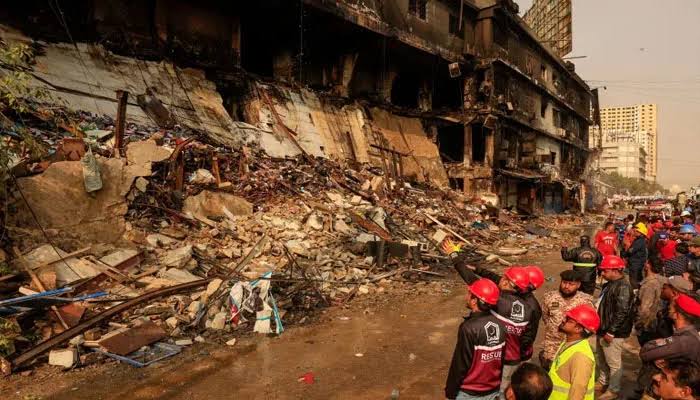
The Sindh Home Department has released the judicial commission report into the Gul Plaza tragedy in Karachi, identifying multiple institutional and administrative failures that contributed to the deaths of more than 70 people in the devastating fire earlier this year.
The report examined the responsibilities of various parties involved in the incident and concluded that the tragedy was not caused by fire alone. Delays, inadequate fire safety measures, blocked exits, darkness and ineffective emergency response significantly reduced the chances of rescuing people trapped inside the building.
In this regard, Gul Plaza remained in commercial use despite being considered dangerous and allegedly violating fire safety regulations. The plaza administration failed to address known deficiencies.
The Civil Defence inspections conducted in 2024 and 2025 reportedly identified the absence of essential fire safety equipment, the presence of inflammable commercial material and shortcomings in emergency exits.
The report further noted that the approved plan had 1,102 shops, while 1,153 shops were actually operating in the building.
The large quantities of combustible commercial goods were also reportedly present inside the premises.
The commission found that the fire brigade’s response did not meet its own prescribed standards.
The report stated that a critical rescue opportunity remained between approximately 11:15pm and 11:20pm, when some victims could still reportedly be seen.
The commission also mentioned the consequences of disconnecting electricity to the building. The resulting darkness made it more difficult for people on upper floors to find their way out.
Despite the presence of a speaker system inside Gul Plaza, the system was reportedly not used during the emergency. The report also raised concerns over inadequate emergency exits and other weaknesses in the building’s safety arrangements.
The report said the failure of Civil Defence was not simply a failure to identify risks, as safety deficiencies had already been documented.
It also noted that the Electric Inspector’s statement indicated that no regular electrical inspection of Gul Plaza had been conducted, despite legal requirements for periodic inspection of electrical installations and equipment.
Report Says Tragedy Was Caused by a Chain of Failures
The commission’s findings suggest that the deaths resulted from a combination of fire, delayed response, darkness, blocked or inadequate escape routes, inactive safety systems and weak institutional coordination.
The fire broke out on January 17 this year at Gul Plaza, a prominent shopping centre on Karachi’s MA Jinnah Road. The blaze continued for three days, killing more than 70 people and leaving the shopping centre completely destroyed.
The report has therefore placed the focus not only on the origin of the fire but also on the failures that allegedly prevented timely evacuation, firefighting and rescue.