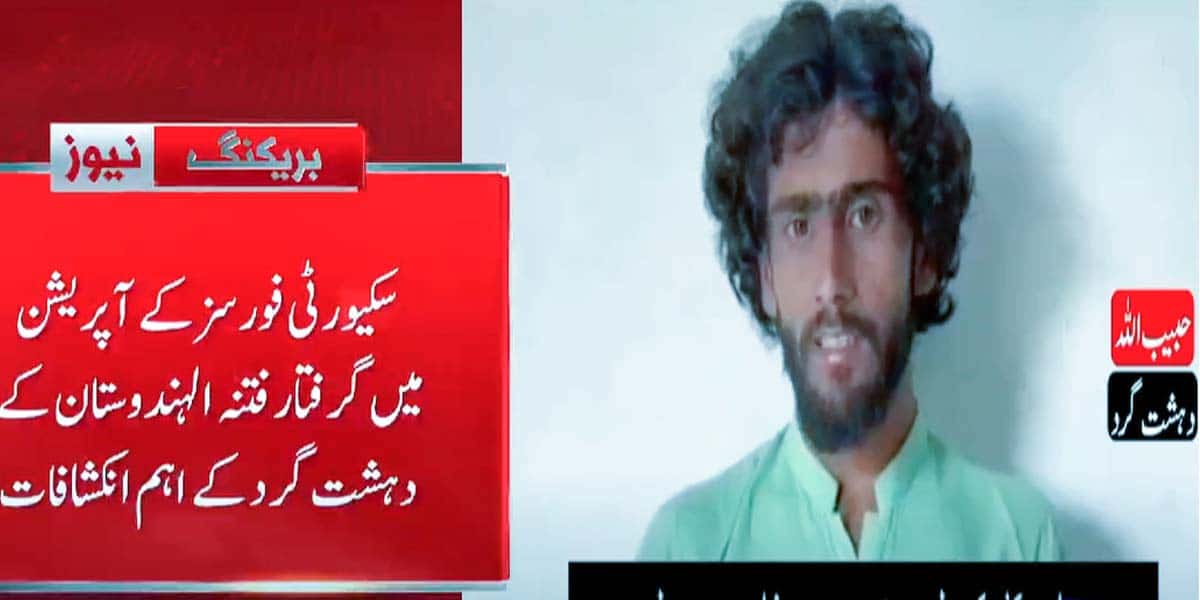
QUETTA: A man arrested during a security operation has made explosive claims about the recruitment and training methods used by an India-backed militant group involved in terror attacks in Balochistan.
The suspect described how young men were allegedly recruited, trained and paid by what Pakistani authorities refer to as “Fitna al Hindustan.” He also outlined the group’s alleged recruitment practices, training camps and operational methods.
The suspect, identified as Habibullah, said he is from the Serandoh area of Ornach tehsil in Khuzdar district, southwestern Balochistan.
According to his video confessional statement, the group recruited him by promising financial rewards and a better future.
He said the group first took him to Chanal Dasht, where he underwent ideological indoctrination. He said he was later sent to the Sargarh camp for military training.
Habibullah claimed instructors trained recruits to use firearms, handle explosives and carry out ambushes. He said they also taught them how to evade capture and conceal their identities after attacks.
He claimed that he received 25,000 Pakistani rupees for participating in militant activities.
The suspect said he came into contact with the group during sit-in protests organized by what Pakistani authorities describe as its proxy organization, the Baloch Yakjehti Committee (BYC).
He claimed he transported weapons, ammunition, explosives, food and medicines to militant groups.
Habibullah also admitted that he took part in attacks in Sanaro Camp, Khuzdar, Nal and Bela. He said the organization provided weapons, operational instructions and communication support before each attack.
He claimed militants received payments for every operation they carried out. He said he was paid 25,000 rupees after attacks in Khuzdar and Bela.
The suspect also alleged that two civilians were killed when militants opened fire during an attack on a police checkpoint in Khuzdar.
Habibullah said many recruits joined the group because they lacked employment opportunities. He alleged the organization lured young men with false promises before coercing them into staying.
He further claimed that members who tried to leave the organization were killed.
He also alleged that militants often lacked adequate food supplies and resorted to looting nearby villages for survival.
The allegations have not been independently verified. Authorities have not released additional evidence to support the suspect’s claims, and the accused group has not publicly responded.