ISLAMABAD: Pakistan and seven other Muslim-majority countries have strongly rejected reported Israeli plans and statements concerning the displacement of Palestinians from the Gaza Strip, warning that any forced removal of civilians from their homeland would have serious legal, humanitarian and regional consequences.
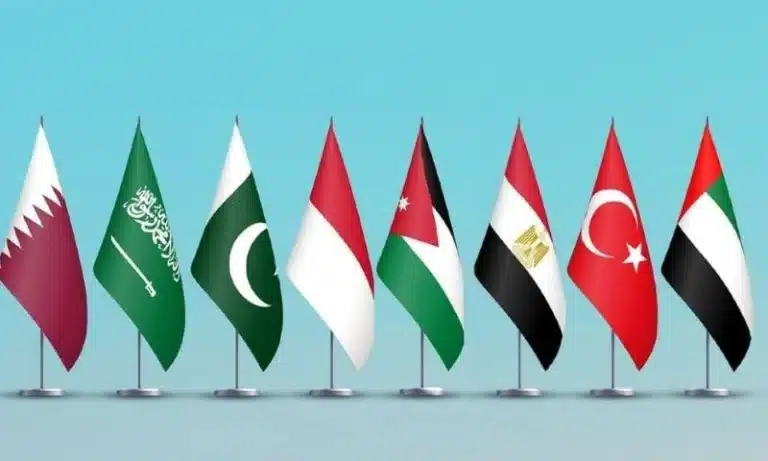
Foreign ministers from Pakistan, Saudi Arabia, Türkiye, Egypt, Indonesia, Jordan, Qatar and the United Arab Emirates issued a joint position opposing any proposal or arrangement aimed at forcibly transferring Palestinians from Gaza.
The eight countries said attempts to remove Palestinians from their homeland would violate fundamental principles of international law and international humanitarian law and would infringe upon what they described as the legitimate and inalienable rights of the Palestinian people.
Eight Muslim States Reject Forced Displacement
The joint statement followed remarks attributed to Israeli National Security Minister Itamar Ben-Gvir and Defence Minister Israel Katz concerning the displacement of Palestinians from Gaza.
The foreign ministers categorically rejected any plans, proposals or arrangements that would result in the forced removal of Palestinians from the territory. The countries warned that transforming calls for displacement into official policy or practical measures could have far-reaching consequences.
According to the statement, such a development could increase instability in the region and undermine international diplomatic efforts aimed at reaching a peaceful resolution to the conflict.
Gaza Considered Integral Part of Occupied Palestinian Territory
The eight countries reaffirmed their position that the Gaza Strip is an integral part of the Occupied Palestinian Territory.They stressed the importance of maintaining the territorial unity of Gaza and the West Bank, including East Jerusalem.The foreign ministers said efforts to alter the territorial or demographic character of the occupied Palestinian territories should be firmly opposed.
They called on the international community to take a clear position against any attempt to establish a new demographic or territorial reality in the occupied territories.
Appeal to UN Security Council
The eight countries specifically urged the international community, including the United Nations Security Council, to oppose measures that could lead to the forced displacement of Palestinians.Their appeal reflects concerns that any major demographic or territorial changes imposed during the conflict could have long-term consequences for the region.The ministers maintained that Palestinians should be allowed to remain on their land and rejected efforts that could marginalise the Palestinian cause or undermine what they described as the legitimate rights of the Palestinian people.
Support for Palestinian Right to Remain
Pakistan and the other seven countries reaffirmed their support for the Palestinian people’s right to remain on their homeland.The statement rejected proposals involving the forced removal of Palestinians and stressed the importance of protecting Palestinian rights.The countries also linked the issue to broader diplomatic efforts aimed at resolving the Israeli-Palestinian conflict.
Their position was that a sustainable peace would require addressing the political rights and territorial claims of the Palestinian people rather than creating new demographic realities.
Two-State Solution Reaffirmed
The foreign ministers reiterated their support for a two-state solution, describing it as the only viable path toward a just and lasting peace. Under the position outlined in the joint statement, an independent Palestinian state should be established on the basis of the June 4, 1967 borders, with East Jerusalem as its capital. The ministers said this approach should be pursued in accordance with relevant international resolutions.
The renewed support for a two-state solution places the latest statement within the broader international debate over how to achieve a lasting settlement between Israelis and Palestinians.
Warning Over Regional Stability
The eight countries warned that forced displacement could have serious consequences for regional peace and stability. They argued that any attempt to forcibly remove Palestinians could further complicate efforts to end the conflict and make a peaceful political settlement more difficult to achieve. The ministers also expressed concern that such measures could undermine international diplomatic initiatives intended to bring an end to the Gaza conflict.
According to the joint statement, preventing forced displacement is therefore not only a humanitarian and legal issue but also an important factor in maintaining regional stability.
US Gaza Peace Plan Mentioned
The statement also referred to US President Donald Trump’s Comprehensive Plan to End the Gaza Conflict. The eight countries said the plan explicitly rules out forced displacement, and they warned that any move in the opposite direction could undermine international efforts to resolve the conflict. By highlighting the plan, the foreign ministers connected their opposition to forced displacement with ongoing international efforts to establish a framework for ending the Gaza conflict.
Pakistan and Muslim States Present Unified Position
The joint statement represents a coordinated position by Pakistan and seven other prominent Muslim countries on the future of Gaza and the rights of Palestinians.The participating countries—Pakistan, Saudi Arabia, Türkiye, Egypt, Indonesia, Jordan, Qatar and the UAE—rejected any proposal that would forcibly remove Palestinians from their homeland.
They stressed the importance of preserving Gaza’s territorial connection with the West Bank and East Jerusalem while reaffirming support for an independent Palestinian state.The ministers also called on the international community to oppose any attempt to impose demographic or territorial changes in the occupied Palestinian territories.