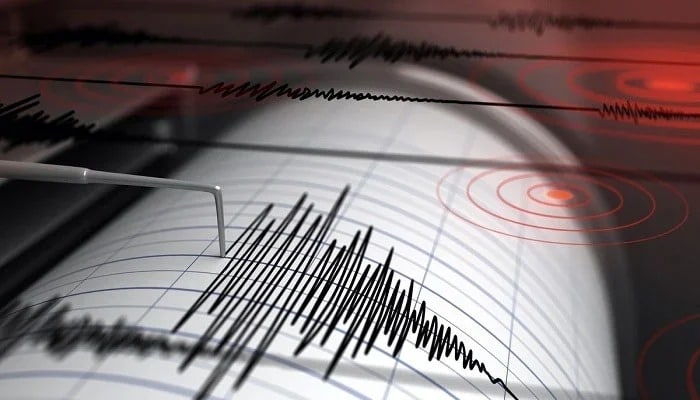
LAHORE: Tremors from an earthquake were felt in Lahore and its surrounding areas.
According to the Seismological Center, the earthquake recorded a magnitude of 4.9 with a depth of 18 kilometers.
The center further stated that the epicenter of the quake was located in the border region between Kashmir and India. Concurrently, social media users also reported experiencing strong tremors across Lahore.
Pakistan is located in a highly seismically active zone, primarily because it sits on the boundary where the Indian and Eurasian tectonic plates collide.
This ongoing geological movement makes the country vulnerable to frequent and sometimes devastating earthquakes.
The northward movement of the Indian plate into the Eurasian plate continuously releases immense energy, resulting in seismic tremors across various regions.
Among the most severely affected areas is Azad Jammu and Kashmir (AJK) and the neighboring regions of Khyber Pakhtunkhwa (KP).
The northern parts of Pakistan, including Gilgit-Baltistan, are particularly prone to high-intensity quakes due to the complex network of fault lines underneath the Hindu Kush, Karakoram, and Himalayan mountain ranges. Historically, the 2005 Kashmir earthquake, which measured 7.6 on the Richter scale, stands out as one of the deadliest disasters in the region, flattening entire cities and causing massive loss of life.
Apart from the mountainous north, the province of Balochistan is another highly vulnerable zone.
Cities like Quetta lie directly on major fault lines, such as the Chaman Fault. Balochistan has faced numerous destructive tremors over the decades, including the catastrophic 1935 Quetta earthquake.
Furthermore, major urban centers in the plains, like Islamabad and Lahore, regularly experience tremors when deep or moderate earthquakes occur in Kashmir or the Hindu Kush region.
Even when the epicenters are located hundreds of kilometers away along the borders, the shockwaves travel through the Indus basin, causing panic in densely populated cities.
Building safety regulations and public awareness remain critical challenges in mitigating the risks posed by these unavoidable natural disasters.