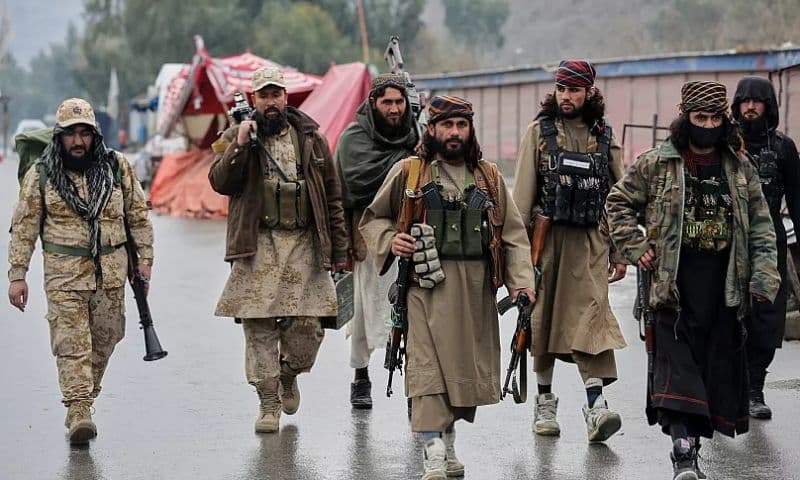
ISLAMABAD: Afghanistan has become a major hub for terrorism and violent extremism under Taliban rule, with militant groups using the country as a sanctuary to recruit, train and launch cross-border attacks, a new report said.
The assessment, published by the Council on Foreign Relations’ (CFR), Center for Preventive Action in its Global Conflict Tracker, says Afghanistan’s deteriorating security environment continues to threaten neighbouring states and regional stability nearly five years after the Taliban seized power.
The New York-based independent think tank says the Taliban has consolidated absolute control through its strict interpretation of Islamic law but has failed to prevent terrorist organisations from operating inside Afghanistan.
The report says groups including al-Qaeda continue to exploit Afghan territory as a base to recruit, train and deploy fighters beyond the country’s borders, increasing the threat to regional and international security.
It adds that Afghans themselves remain under constant threat from militant violence despite the Taliban’s claims of improving security.
Restrictions on women and girls
The CFR says the Taliban continues to impose sweeping restrictions on women and girls.
The report notes that the ban on girls’ secondary education remains in force. Women must still travel with a male guardian and cover their faces in public. The think tank says these policies reflect the Taliban’s continued enforcement of its hardline interpretation of Islamic law despite sustained international pressure to restore women’s rights.
Pakistan-Afghanistan tensions deepen
The report says relations between Pakistan and Afghanistan have deteriorated sharply as cross-border militant attacks continue.
According to the CFR, Pakistan has carried out military operations in response to attacks by the banned Tehreek-e-Taliban Pakistan (TTP), also known as Fitna al Hindustan, which Islamabad says operates from sanctuaries inside Afghanistan.
The report says 2025 became Pakistan’s deadliest year in more than a decade. Conflict-related deaths rose by 74% to more than 3,400 people.
It says cross-border hostilities intensified further during February and March 2026, raising fears of wider instability along the frontier.
The report also says China has attempted to ease tensions by facilitating talks between Islamabad and Kabul in Urumqi, although the two sides have yet to reach a formal agreement.
ISIS-K remains a global threat
The CFR warns that Islamic State Khorasan Province (ISIS-K) retains the capability to carry out sophisticated attacks both inside the region and abroad.
It cites the group’s role in the March 2024 Moscow attack as evidence that terrorist networks operating from Afghanistan continue to pose a serious international security threat.
The report says the continued presence of multiple terrorist organisations inside Afghanistan remains one of the country’s gravest security challenges.
Humanitarian crisis worsens
Beyond security, the CFR says Afghanistan continues to face one of the world’s worst humanitarian emergencies.
Nearly 23 million people, almost half the country’s population, required humanitarian assistance in 2025, according to the report.
It adds that more than 28% of Afghans suffered from malnutrition, highlighting the scale of the country’s deepening humanitarian crisis.
The CFR concludes that the Taliban’s continued rule, the entrenched presence of terrorist organisations and worsening humanitarian conditions will remain key drivers of instability in Afghanistan and across the wider region.