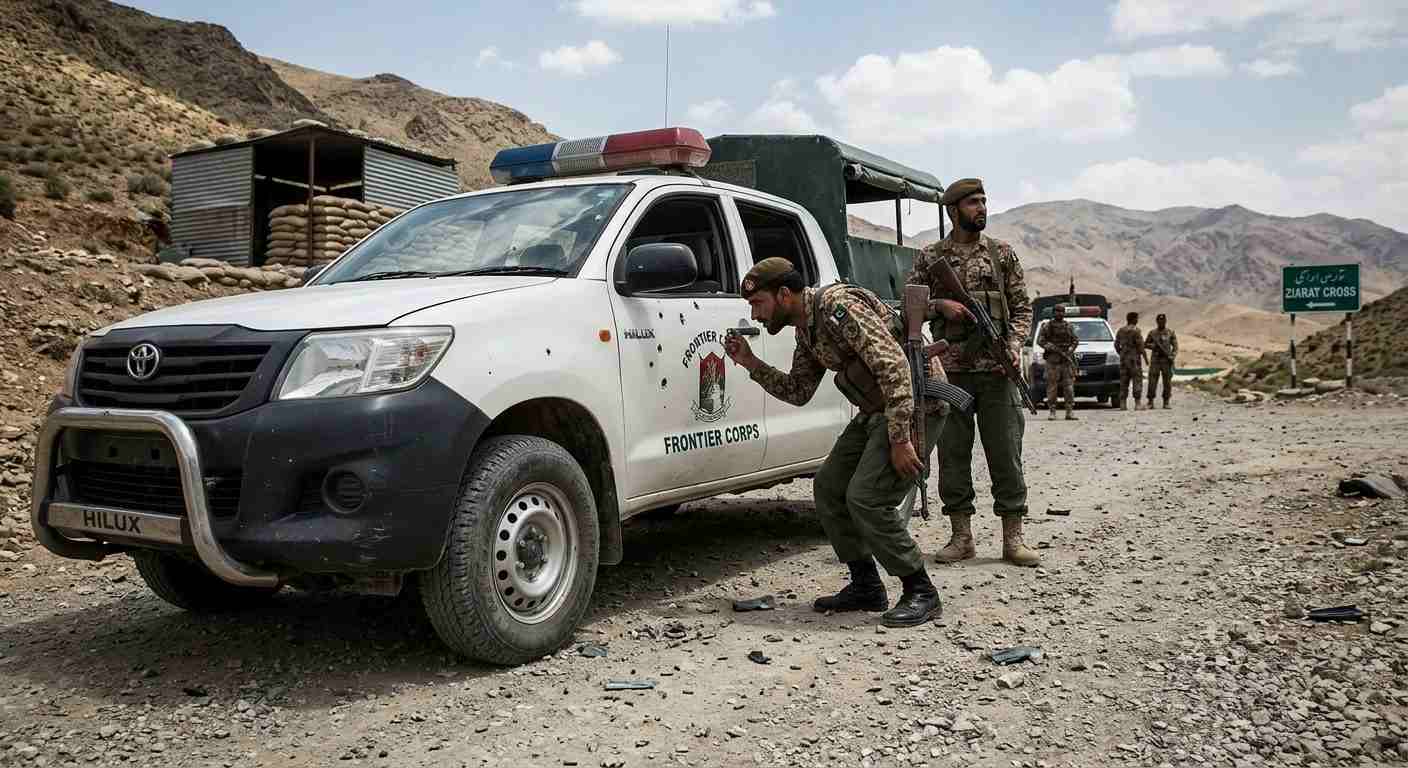

QUETTA: Conflicting claims over the September 3 attack near Ziarat Cross in Balochistan’s Pishin district have once again brought the reported Baloch Liberation Army (BLA)-Tehreek-e-Taliban Pakistan (TTP) nexus into focus.
The dispute over responsibility and casualties has also raised questions about cooperation among militant groups that operate under different names but, according to United Nations reporting, have established contacts involving training, logistics and resources.
What Happened at Ziarat Cross?
On September 3, militants attacked a Frontier Corps contingent near Ziarat Cross in the Kuch Mor area of Pishin district.
According to available information, security forces responded to the attack and killed 11 militants, while eight security personnel were martyred and another was wounded.
Initial reports indicated that the attackers targeted an FC party and a security contingent accompanying the Assistant Commissioner of Harnai.
However, the BLA later claimed responsibility, saying its fighters had attacked a security forces convoy and killed 18 personnel. Some media outlets, including Indian media, also reported the BLA’s claim.
The figures differed sharply from Pakistan’s reported casualties.
The conflicting claims do not establish who carried out the attack, but they have renewed attention on the reported relationships between militant organisations operating in Pakistan and Afghanistan.
The BLA-TTP Connection
The BLA and TTP have different ideological and political objectives and have traditionally operated in different areas. Nevertheless, UN reporting has cited information from member states pointing to cooperation between the two groups.
The UN Security Council’s Analytical Support and Sanctions Monitoring Team, in its 38th report, cited information from a member state that BLA fighters received training in Afghanistan from Al-Qaeda trainers alongside TTP militants.
The report also said Al-Qaeda had long provided the TTP with ideological guidance, training and support.
These findings indicate that militant groups can cooperate operationally despite differences in their stated objectives.
From Training to Logistics
The reported links go beyond training.
Another UN report cited information from member states that the BLA had cooperated with the TTP and Islamic State Khorasan (IS-K) through joint training camps and shared resources. It also referred to coordination around attacks and meetings between commanders.
The same reporting identified alleged logistical links between the BLA and IS-K.
These relationships matter because they can give militant organisations access to expertise, personnel and logistical capabilities that they may not possess independently.
Al-Qaeda and IS-K
Al-Qaeda forms another important part of the picture.
According to the UN reporting, the organisation has maintained longstanding ties with the TTP, providing ideological guidance, training and support.
Meanwhile, reported contacts between the BLA and IS-K add another dimension to the militant landscape. Although the groups have distinct ideologies and objectives, UN member-state information has pointed to cooperation involving training, resources and logistics.
Afghanistan’s Role
Afghanistan remains central to these reported connections.
The UN’s 38th report said Afghan authorities had moved around 2,000 TTP fighters and their families from areas close to the Pakistani border to locations deeper inside Afghanistan.
The report also referred to information that Taliban leader Hibatullah Akhundzada had warned TTP leaders to stop attacks against Pakistan.
Despite such reported measures, the UN continued to express concern over the TTP’s infrastructure and its links with other militant groups.
What the Ziarat Cross Attack Reveals
The Ziarat Cross incident does not, on its own, prove that the BLA and TTP jointly planned or executed the attack. However, the competing claims have highlighted a problem that extends beyond attribution: militant groups can operate separately while maintaining contacts that facilitate training, movement, resources and logistics.
For Pakistan, this makes counterterrorism more complicated. Security agencies must not only identify those responsible for individual attacks but also disrupt the infrastructure that enables militants to train, finance operations, move weapons and maintain cross-border contacts.
The UN reports suggest that these relationships involve more than one organisation. The TTP’s reported ties with Al-Qaeda, the BLA’s reported contacts with the TTP and IS-K, and the alleged logistical connections among some of these groups point to a security challenge that crosses organisational boundaries.
Against this backdrop, the Ziarat Cross attack has once again put the BLA-TTP nexus under scrutiny. While responsibility for the specific attack remains contested, the incident has renewed questions about how cooperation among militant groups could shape Pakistan’s evolving security threat.