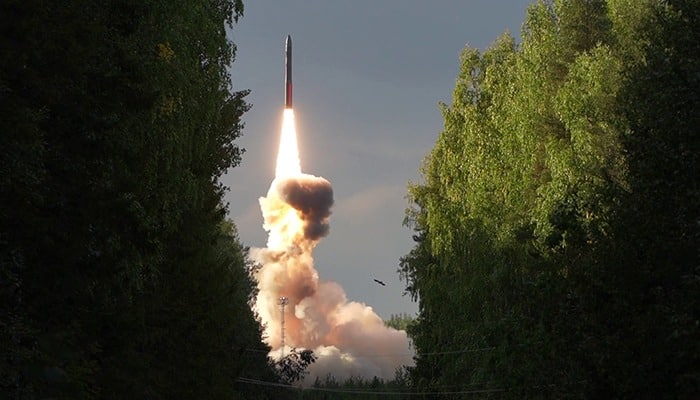
MOSCOW: The Russian Ministry of Defense announced that it has successfully test-fired a solid-fuel mobile intercontinental ballistic missile (ICBM) from the Plesetsk Cosmodrome in the northwestern Arkhangelsk region during military exercises.
Prior to the launch, Russian strategic missile forces deployed a mobile launcher battery to a remote area.
The missile was then fired toward the Kura test site on the Kamchatka Peninsula in the country’s eastern part, covering a distance of over 6,700 kilometers.
The Russian military stated that the primary objective of this test was to verify the “tactical, technical, and flight characteristics” of the missile system.
The defense ministry’s statement confirmed that “all designated targets were fully achieved,” and that the missile maintained an “flawless, accurate flight path” toward its target.
While the statement did not disclose the specific identity of the missile used in this test, reports indicate that the defense ministry had previously tested the ‘RS-24 Yars’ missile system in mid-May as part of missile forces drills.
This latest missile test by Russia comes at a time when, less than a week prior, unverified reports claimed that Ukrainian drones had attempted to target Russia’s sole military spaceport, Plesetsk.
A solid-fuel mobile intercontinental ballistic missile (ICBM) represents a pinnacle of modern strategic military engineering, designed to deliver nuclear payloads across intercontinental distances exceeding 5,500 kilometers.
Unlike older liquid-fueled systems that require lengthy, vulnerable fueling procedures right before launch, solid-propellant missiles store their chemical fuel and oxidizer already mixed inside the motor casing.
This critical technological advantage allows solid-fuel ICBMs to remain in a state of constant operational readiness, capable of being launched within minutes of receiving a command.
Furthermore, their deployment on transporter-erector-launcher (TEL) vehicles provides high mobility across vast road networks or rugged terrain.
This mobility makes them exceptionally difficult for adversaries to track, target, and neutralize via preemptive strikes, thereby reinforcing second-strike nuclear deterrence.
ALSO READ: US Running Short of Missiles for Long Iran War: Reports
Major nuclear powers continually refine these systems to enhance survival capabilities, shorten response times, and counter advanced missile defense shields.