WASHINGTON: The story of Noah’s Ark holds monumental significance in human history, traditionally credited with preserving humanity and various species during a catastrophic global flood.
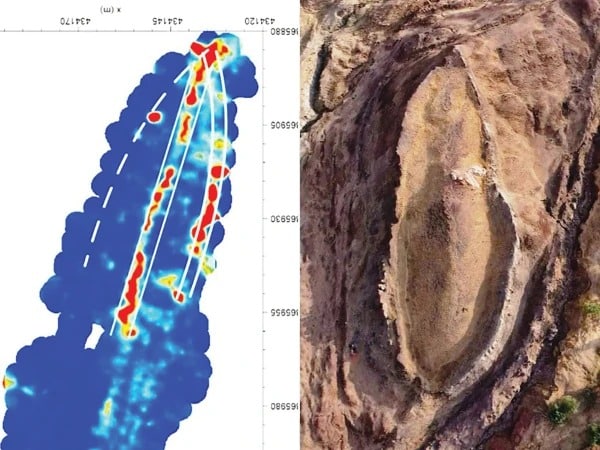
According to historical and regional lore, the legendary vessel finally came to rest in eastern Turkey at the Durupinar site on Mount Tendürek, a geological formation whose contours bear a striking resemblance to a massive ship.
While mainstream geologists have previously argued that the 515-foot structure is merely a natural geological formation, recent developments have brought the site back into global focus.
Prominent Turkish-American military scientist Dr. Khusro Bakhtiyar recently utilized his indigenously developed “Bakhtiyar Radar” to scan subsurface layers at the location.
This groundbreaking subsurface scan has sparked immense excitement and debate among religious and scientific circles worldwide.
Dr. Bakhtiyar now intends to lead an archaeological team to excavate the site to uncover and present whatever lies buried beneath the surface to the world.
Interestingly, while the Holy Quran identifies the resting place of the ark as Mount Al-Judi, the exact geographical coordinates have remained a subject of extensive scholarly interpretation, with local Turkish tradition even naming a peak on Mount Tendürek as Al-Judi.
Quranic Context and Perspective on the Ark of Noah
The narrative of Prophet Noah (A.S.) and the Great Ark occupies a foundational place in Islamic theology, serving as a profound divine lesson on faith, obedience, and the consequences of moral corruption. In the Holy Quran, the account of the flood (Toofan-e-Nuh) is detailed across several Surahs, most notably in Surah Hud, Surah Al-Anbiya, and Surah Al-Mu’minun.
The Quranic narrative establishes that Noah (A.S.) spent centuries preaching to his people before receiving divine command to construct a massive vessel under heavenly guidance to save the believers and pairs of every animal species.
Unlike folkloric accounts that focus heavily on the physical dimensions or structural remains of the vessel, the Quranic perspective emphasizes the spiritual dimensions of the event.
It portrays the ark not merely as a technological marvel of survival, but as a vessel of divine salvation (Fulk-e-Mashhoon) floating upon waves like mountains under the direct protection of God.
Regarding the final resting place of the vessel, Surah Hud explicitly states that the ark came to rest on Mount Al-Judi (“And it was said, O earth, swallow your water and, O sky, withhold [your rain]. And the water subsided, and the matter was accomplished, and the ship came to rest on the [mountain of] Judi”).
Islamic scholars and exegetes have long debated the precise physical location of Mount Al-Judi, traditionally associating it with the mountainous border region connecting modern-day Turkey, Iraq, and Syria.
While modern archaeological expeditions—such as those exploring claims regarding the ark of Noah—generate immense public curiosity, Islamic theology places primary emphasis on the moral and historical reality of the event rather than the physical preservation of its remnants.
For millions of believers, the enduring legacy of the ark of Noah in the Quran serves as an eternal reminder of divine justice, mercy, and a renewed covenant between Creator and humanity.
ALSO READ: Ronaldo’s Astounding Per-Minute Earnings
Tags: Noah’s Ark Discovery, Mount Al Judi, Dr Khusro Bakhtiyar, Durupinar Site Turkey, Quranic Stories of Prophets, Islamic History and Archaeology, Global Flood Narrative