RAWALPINDI: Pakistan’s military said on Friday that security forces have killed an average of 10 militants a day this year while carrying out nearly 2,000 intelligence-based operations (IBOs) daily as part of an intensified nationwide counterterrorism campaign.
The military’s media wing, the Inter-Services Public Relations (ISPR), said security forces and law enforcement agencies have conducted 40,348 intelligence-based operations across the country so far in 2026 against militants linked to Fitna al Khawarij and Fitna al Hindustan.
According to the ISPR, 31,080 operations were carried out in Balochistan, 7,177 in Khyber Pakhtunkhwa, and 2,091 in the rest of the country.
The ISPR said security forces killed 2,084 militants during the period, averaging 10 militant deaths per day, which it described as the highest daily rate recorded in Pakistan’s counterterrorism operations.
The military said 3,145 terrorist incidents were reported during the same period. Of those, 1,971 occurred in Khyber Pakhtunkhwa, 1,148 in Balochistan and 26 elsewhere in the country.
He said security forces killed 2,597 militants during 2025. In comparison, they have killed 2,084 militants so far this year, despite only part of the year having elapsed. He said the figures reflected the increasing intensity and effectiveness of military operations.
28 Suicide Attakcs in 2026
The DG ISPR said that Afghan nationals have played a significant role in recent militant attacks inside the country, adding that most of this year’s suicide bombers were Afghan citizens.
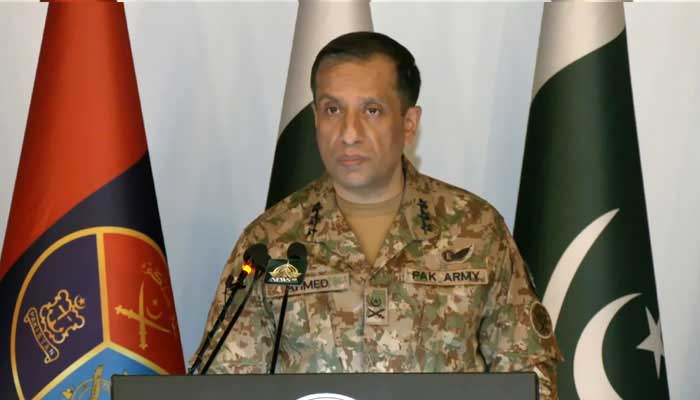
Speaking at a news briefing, Inter-Services Public Relations (ISPR) Director General Lt. Gen. Ahmed Sharif Chaudhry said 28 suicide attacks had been recorded in Pakistan so far this year. He said most of the bombers involved were Afghan nationals. He also linked recent attacks in Tank and Karachi to Afghan militants.
The military spokesman said security forces had intensified counterterrorism operations across the country, leading to a sharp rise in militant casualties.
The military also said 819 people, including security personnel and civilians, were killed in terrorist attacks during the period, averaging four deaths per day.
Of the total, 303 were Pakistan Army personnel, 194 were members of other law enforcement agencies, and 322 were civilians.
The ISPR said security forces and law enforcement agencies will continue intelligence-led operations across the country to dismantle militant networks and prevent attacks.
No Talks with Terrorists: ISPR
During the briefing, the ISPR ruled out any negotiations with militant groups. It said terrorists had only two options: surrender to the state or face proactive military operations by Pakistan’s security forces.
The ISPR said Pakistan’s security forces remained committed to eliminating militancy and would continue intelligence-based operations to maintain peace and stability.
He added that authorities were also expanding efforts against individuals and networks accused of facilitating or supporting militant groups.
The military spokesman said official data showed security operations had become more effective than in previous years.
He said casualty figures among security personnel were higher in 2023, but recent operations had resulted in greater success against militant groups.
Addressing questions about the increase in militant attacks, Chaudhry said the rise was partly the result of intensified military pressure on militant networks.
“The question is valid,” he said. “One reason for the increase in attacks is that security forces have significantly stepped up operations and pressure on terrorist groups.”
He said militant organizations had adapted after failing to achieve their objectives through direct attacks.
According to Chaudhry, they expanded their activities and logistical support from areas in Afghanistan under the control of the Taliban administration.
The military spokesman reiterated that Pakistan’s position on militant groups was unequivocal.
“There will be no negotiations with terrorists,” he said.
He said militants had only two options: surrender to the state under the Constitution and the law or face military operations.
Chaudhry said the military would also present a detailed briefing on the security situation in Balochistan, including reasons behind the rise in militant attacks and the state’s counterterrorism strategy.
He said the figures should concern the entire nation.
Misleading Narrative About Security Situation in Balochistan
The ISPR rejected what it described as attempts to create a misleading narrative about the security situation in Balochistan, saying the province remains under the state’s control despite an increase in militant attacks.
Director General Lt. Gen. Ahmed Sharif Chaudhry said the rise in reported attacks should be viewed alongside the sharp increase in security operations.
He said areas where security forces conduct more operations naturally witness more encounters with militants, resulting in a higher number of reported attacks.
“The increase in incidents reflects intensified pressure on terrorist groups,” he said. “As security forces expand operations, militants also attempt more attacks in response.”
Chaudhry said Pakistan is a constitutional state where all institutions operate under the rule of law.
He rejected criticism describing Pakistan as a “hard state,” saying the term had been used to create a negative impression of measures aimed at enforcing the law.
“A state becomes strong when the Constitution and the law apply equally to everyone,” he said. “No individual or group should receive special treatment.”
He said equal application of the law strengthens national security, stability and public order.
The military spokesman said attempts to distort facts about Balochistan were intended to undermine confidence in state institutions and question government actions.
He said Pakistan would continue to manage its affairs in accordance with the Constitution, the law and the writ of the state.
Rights come with responsibilities
Chaudhry said citizens should fulfill their constitutional responsibilities before demanding their rights.
He said public debate often focused on rights while overlooking the duties assigned to citizens under the Constitution.
He cited Article 5 of Pakistan’s Constitution, which requires loyalty to the state and obedience to the Constitution and the law.
“Fundamental rights are inseparable from fundamental responsibilities,” he said.
Chaudhry urged citizens to place their constitutional obligations above personal interests.
He said Field Marshal Syed Asim Munir had recently conveyed the same message while addressing the National Workshop Balochistan, stressing that every citizen’s foremost identity should be that of a Pakistani.
National identity should come first
The military spokesman said national identity should take precedence over ethnic, linguistic or provincial affiliations.
“Our first and foremost identity should be Pakistani,” he said. “Provincial or ethnic identities should not come before our national identity.”
He said the state guarantees the country’s politics, security, economy and national identity.
“If the state remains strong, our security, prosperity and identity will remain secure,” he said.
Chaudhry said Balochistan’s challenges extended beyond militancy.
Tribal System Holding Back Balochistan’s Development, ISPR Says
He argued that the province’s long-standing tribal and feudal system had deprived many people of education, economic opportunities and social mobility.
According to the military spokesman, influential groups have sought to preserve the existing system by preventing ordinary citizens from advancing through education, professional careers and business opportunities.
He said the state’s objective was to promote development, equal opportunities and the rule of law throughout the province.
Pakistan Needs a ‘Hard State’ With Equal Law for All
During the briefing, Chaudhry also stressed the need for what he described as a “hard state.” “We have to make our country a hard state. Hard state does not mean a state controlled by the military, but rather a state where everything is done according to the constitution and the law is the same for everyone. There is no elite in it.”
He said a hard state meant one where the Constitution and the rule of law apply equally to all citizens.