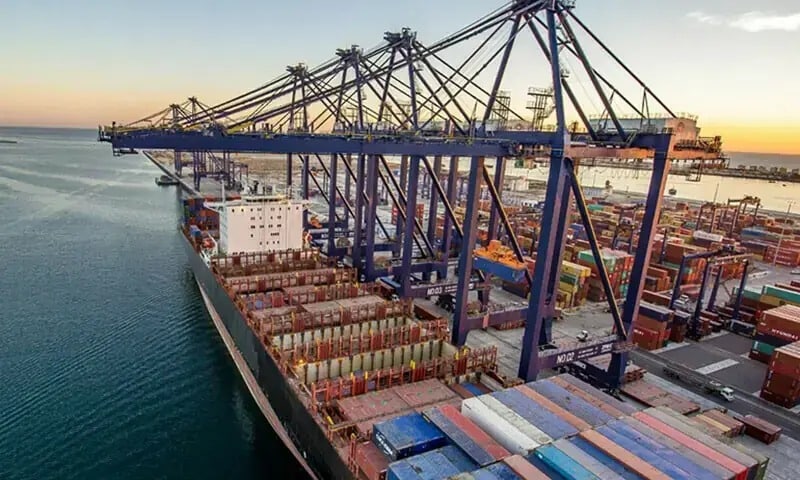
Karachi: In a major boost to Pakistan’s maritime sector, Karachi Port has crossed a significant milestone by welcoming over 2,000 ships in a single year—a feat achieved after a gap of eight years.
Federal Minister for Maritime Affairs, Junaid Anwar Chaudhry, officially announced the achievement, revealing that a total of 2,003 ships berthed at Karachi Port during the fiscal year.
This represents a notable 7.5% increase in ship arrivals compared to the previous year, signaling a robust revival in port operations and maritime trade.
The Minister further detailed that the total cargo volume handled surpassed 84.4 million tons, while the Gross Registered Tonnage (GRT) witnessed a 3% growth.
He termed this surge a highly positive indicator for the national economy, reflecting revitalized commercial activity.
Chairman of the Karachi Port Trust (KPT), Shahid Ahad, attributed this historic success to enhanced shipping activities and modernized operational efficiency.
He emphasized that better administrative strategies and streamlined port operations made this milestone possible. Established in 1887, Karachi Port continues to stand as Pakistan’s premier maritime gateway, playing a central role in driving both national and international trade.
[ Arabian Sea Shipping Lanes ]
|
+——————-+——————-+
| |
[ Karachi Port ] [ Gwadar Port ]
– Established Gateway – Deep-Sea Mega Port
– Focus: Local Cargo & Transshipment – Focus: Transit Trade & CPEC
Transshipment Potential of Karachi and Gwadar Ports
Transshipment—the unloading of goods from one ship and loading them into another to reach a final destination—is the backbone of global maritime hubs.
In Pakistan, the strategic positioning of Karachi Port and Gwadar Port offers a gateway to landlocked Central Asian Republics (CARs), Western China, and regional Arabian Sea routes.
- Karachi Port: Historically a gateway for domestic cargo, Karachi Port (alongside Port Qasim) has progressively upgraded its infrastructure to capture regional transshipment traffic.
- With its deep-water electronic terminals and decades of operational experience, it acts as a reliable transit route for blue-chip shipping lines looking to re-route cargo toward regional markets.
- Gwadar Port: Situated closer to the mouth of the Persian Gulf, Gwadar is custom-built as a deep-sea mega-port tailored for massive transshipment volumes.
- Under the China-Pakistan Economic Corridor (CPEC), Gwadar offers a shorter, more cost-effective transit alternative for Western China and Central Asia.
While Karachi Port provides immediate operational strength and steady handling capacity, Gwadar represents the future of Pakistan’s blue economy.
Together, their combined transshipment potential can transform Pakistan into a centralized logistics hub for South and Central Asia.