ISLAMABAD: The federal government has launched a simplified tax scheme aimed at bringing small shopkeepers into the national tax net.
Minister of State Bilal Azhar Kiyani announced that the new initiative features a convenient, one-page application form open to both registered tax filers and non-filers.
The scheme applies directly to businesses with annual sales of 200 million PKR or less, while a standard one percent tax will be levied on sales exceeding that threshold.
Under the rules of the program, participating shopkeepers will be required to make a minimum annual tax payment of 25,000 PKR.
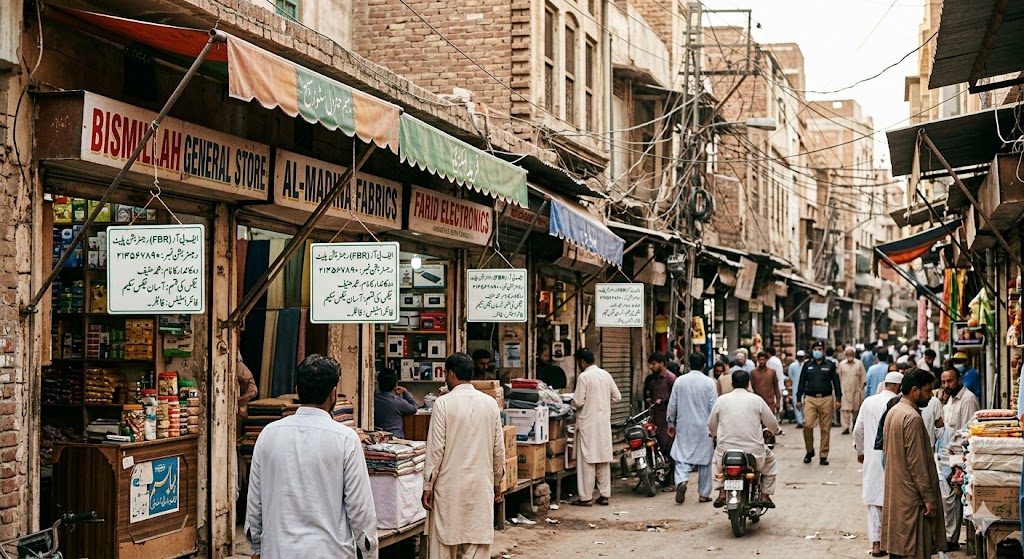
To streamline enforcement, the Federal Board of Revenue (FBR) will issue an official identification plate to participating merchants, displaying their name and business details for prominent display at their shops.
Shops displaying this official plate will be exempt from routine compliance inquiries, whereas retailers who opt out of the scheme will be subject to audit.
Minister Kiyani emphasized that the initiative was designed and implemented in close consultation with the Anjuman-e-Tajiran (traders’ association) to address their long-standing demands.
Speaking on the occasion, Finance Minister Muhammad Aurangzeb reiterated that the scheme is tailored specifically to protect and support small retailers.
He stated that the initiative is projected to successfully incorporate at least four million shopkeepers into the tax net.
Furthermore, business owners who enroll in the program will enjoy an exemption from withholding tax requirements.
To understand where Pakistan’s new retail tax initiative stands globally, it is helpful to contrast it with the established economic frameworks of Europe and the Gulf Cooperation Council.
Pakistan’s strategy of utilizing a flat-rate minimum fee, a single-page form, and a physical storefront plate is a transitional method designed to coax a massive, informal cash economy into the formal sector. In contrast, European and Gulf nations rely on highly automated, digital-first infrastructure where virtually no business operates outside the state’s view, rendering voluntary, simplified entry schemes unnecessary.
In Europe, small shopkeepers are fully integrated into the national grid primarily through structured income tax brackets and Value Added Tax systems.
Most European nations protect micro-businesses by setting an annual turnover threshold, meaning a shopkeeper does not have to register for or charge sales tax until they reach a certain revenue level.
However, unlike Pakistan’s model, these European shopkeepers are still legally required to file regular income tax returns based on their exact profits.
Furthermore, European authorities enforce compliance through technology rather than physical inspections.
Countries like Italy, Poland, and Germany mandate the use of certified, tamper-proof electronic cash registers linked directly to national tax servers, ensuring every digital and cash transaction is logged instantly.
The Gulf states have undergone a similar transformation toward total digital oversight.
Historically known for being tax-free, countries like Saudi Arabia and the United Arab Emirates introduced a uniform five percent tax framework over the last several years.
The Gulf region entirely bypassed the need for manual, transitional filing schemes by leaping straight into advanced digital tracking.
Small neighborhood grocery stores across the region are now bound by strict electronic invoicing mandates, requiring them to use billing systems that generate digital, government-linked receipts.
Ultimately, while Pakistan is attempting to bridge its revenue gap through voluntary compliance incentives and basic administrative exemptions, Western and Gulf economies maintain zero separation between small retailers and mainstream tax laws, using absolute digital integration to ensure every storefront is automatically accounted for.