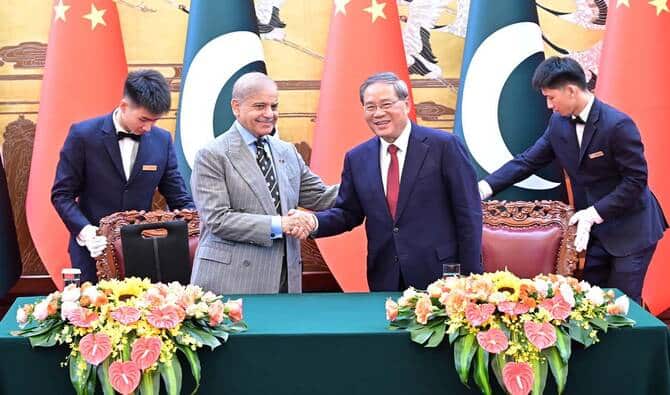
ISLAMABAD: Prime Minister Shehbaz Sharif on Monday thanked Chinese President Xi Jinping and Beijing’s leadership for backing Pakistan’s mediation efforts in the US-Iran talks. He said recent diplomacy had produced major progress toward regional peace.
Pakistan has intensified diplomatic coordination with China during months of tensions between the United States and Iran following joint US-Israeli strikes on Iran in February. The crisis disrupted shipping through the Strait of Hormuz and raised fears of a wider regional conflict involving Gulf states.
Pakistan and China jointly promoted a five-point peace plan calling for a ceasefire, dialogue, protection of civilians and nuclear facilities, safe navigation through the Strait of Hormuz and adherence to the UN Charter.
“The world is passing through a very critical moment. Pakistan has played a sincere role in mediating between the United States and Iran,” Sharif said during talks with Chinese President Xi and Premier Li Qiang in Beijing.
“I thank President Xi Jinping and the Chinese leadership for supporting Pakistan’s efforts to promote peace,” he added.
Shehbaz Sharif said diplomatic efforts had already achieved significant progress and developments were moving in the right direction.
The prime minister also praised Pakistan’s Chief of Army Staff Field Marshal Asim Munir for his role in the mediation process after his recent visit to Tehran.
“He played an important role in contacts with Iranian and American leadership alongside Deputy Prime Minister Ishaq Dar and with counterparts in Gulf countries,” Sharif said.
Pakistan’s military said on Saturday that Munir’s talks in Tehran produced “encouraging progress” toward a final understanding linked to US-Iran negotiations.
During the meeting in Beijing, Pakistan and China also signed several agreements and memorandums of understanding covering trade, agriculture, climate cooperation, education, media, technology and institutional exchanges.
According to the Prime Minister’s Office, the agreements included new protocols to expand Pakistani agricultural exports to China, including dried fruits, nuts and maize. Officials said the measures would help Pakistani farmers and exporters gain better access to Chinese markets.
The two countries also signed agreements on agricultural development and animal vaccines as Pakistan seeks to modernize its farming and livestock sectors.
Other agreements focused on climate cooperation, economic planning, scientific collaboration and workforce development. Pakistan is seeking greater Chinese support in technology transfer and industrial modernization.
Pakistan’s Foreign Service Academy and China Foreign Affairs University also signed a cooperation agreement. Both countries agreed to expand governance and policy training exchanges between state institutions.
In the media sector, Xinhua News Agency signed an agreement with Pakistan Broadcasting Corporation, while China Media Group and Pakistan Television agreed to jointly produce documentaries.
The two sides also signed an agreement supporting free trade and multilateralism. China’s Zhejiang province and Pakistan’s Punjab province established a new sister-province partnership to promote economic and cultural cooperation.
The Prime Minister’s Office said the agreements reflected the growing depth and diversity of Pakistan-China cooperation and opened new opportunities in sectors linked to public welfare and economic growth.
Both countries also agreed to accelerate the next phase of the China-Pakistan Economic Corridor (CPEC), Beijing’s flagship infrastructure initiative in Pakistan under the Belt and Road Initiative.
Sharif said Pakistan remained committed to the “high-quality development” of CPEC, with future cooperation focused on industrialization, agriculture, connectivity, clean energy, science, technology and digital transformation.
He also stressed cooperation in emerging sectors such as artificial intelligence, advanced technologies and space collaboration following Pakistan’s inclusion in China’s space station program.
On Sunday, Pakistani and Chinese companies signed agreements and memorandums of understanding worth $1.22 billion covering renewable energy, electric vehicles, pharmaceuticals, agriculture and smart technologies.