ISLAMABAD: Several Muslim-majority countries, including Pakistan, Saudi Arabia, Turkey, the United Arab Emirates, Jordan, Egypt, Qatar, Indonesia, Kuwait, Oman, Bahrain, Lebanon, and Syria, along with the State of Palestine, have strongly condemned statements made by US Ambassador to Israel Mike Huckabee.
The joint statement, issued by the foreign ministries of these nations and endorsed by the Organization of Islamic Cooperation (OIC), the Arab League (LAS), and the Gulf Cooperation Council (GCC), described Huckabee’s remarks as irresponsible, dangerous, and inflammatory. The statement declared that such comments violate principles of international law, the United Nations Charter, and diplomatic norms.
It emphasized that the remarks pose a serious threat to regional security, stability, and ongoing efforts to achieve peace, including efforts to end the conflict in Gaza.
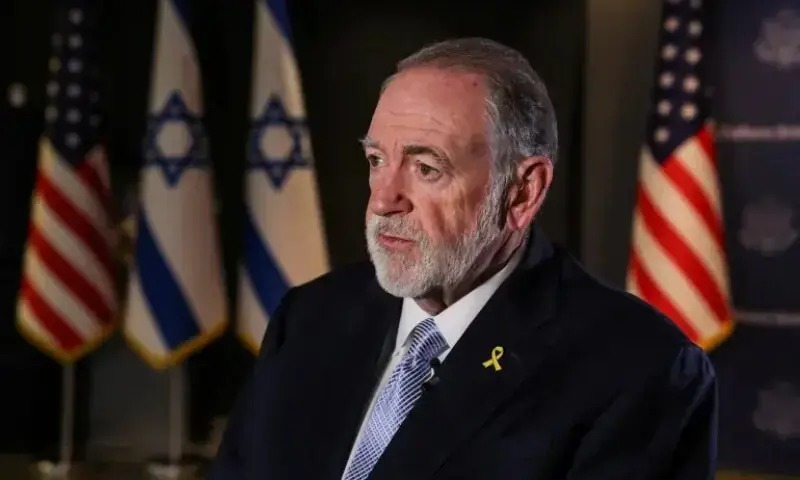
The condemnation directly addressed Huckabee’s comments in a recent interview with commentator Tucker Carlson, where he responded to a question about biblical interpretations granting Israel rights to land from the Nile River to the Euphrates River—a concept associated with the “Greater Israel” ideology, encompassing parts of modern-day Egypt, Lebanon, Syria, Jordan, Iraq, and Saudi Arabia.
Huckabee stated that “it would be fine if they took it all,” while later clarifying that Israel is not seeking such expansion and is focused on security in its current territory, describing his initial response as somewhat hyperbolic.
The joint statement affirmed that Israel holds no sovereignty over occupied Palestinian territories or any other occupied Arab lands.
It stressed that these statements contradict established international positions on territorial integrity and sovereignty, and undermine comprehensive peace initiatives, including those aligned with President Donald Trump’s vision for resolving the Gaza conflict.
This unified response from Arab and Muslim states highlights deep concern over the implications of the ambassador’s words for bilateral relations and broader Middle East stability.
The controversy emerged amid heightened regional tensions, with the remarks drawing sharp criticism for promoting extremist rhetoric incompatible with international law and peaceful coexistence.